
Exercise and Brain Health: How Movement Protects Cognitive Function
How does exercise protect brain health? Exercise is one of the most effective lifestyle interventions for long-term cognitive resilience. Regular movement improves cerebral blood flow, stimulates BDNF (brain-derived neurotrophic factor), reduces chronic inflammation, and improves the metabolic and vascular health that the brain depends on. Aerobic training, resistance training, and higher-intensity efforts each support cognitive health through different but overlapping mechanisms — and the protective effects appear to accumulate across years and decades.
What's in this post?
Why the brain doesn't age in isolation: The systems exercise influences simultaneously.
How exercise changes brain biology: Blood flow, neuroplasticity, and metabolic health.
BDNF and neuroplasticity: What the research actually shows.
Aerobic fitness and brain aging: VO₂ max, hippocampal volume, and dementia risk.
Strength training and cognitive resilience: Why muscle health matters for the brain.
Does intensity matter? Higher-intensity exercise and what we know.
How we think about exercise for brain health at Ikigai: A practical framework.
Does Exercise Protect the Brain?
For years, exercise was framed mostly around weight, appearance, or cardiovascular fitness. Now, the conversation is changing.
Some of the strongest and most consistent data in longevity medicine points to something much bigger: the health of the brain may be deeply tied to the health of the body in motion. Large observational studies consistently show that people who remain physically active throughout life appear less likely to develop cognitive decline, dementia, depression, frailty, and loss of independence. They also tend to maintain better executive function, processing speed, emotional resilience, sleep quality, and metabolic health as they age.
Importantly, this relationship appears to persist even after researchers adjust for many known confounders, though observational studies can never fully eliminate the possibility of reverse causation or residual bias. Still, the consistency of the signal across decades of research is difficult to ignore.
The brain does not age in isolation. It ages in the context of blood flow, metabolic health, inflammation, muscle mass, sleep quality, vascular function, social engagement, stress, and physical capacity. Exercise touches nearly all of them.
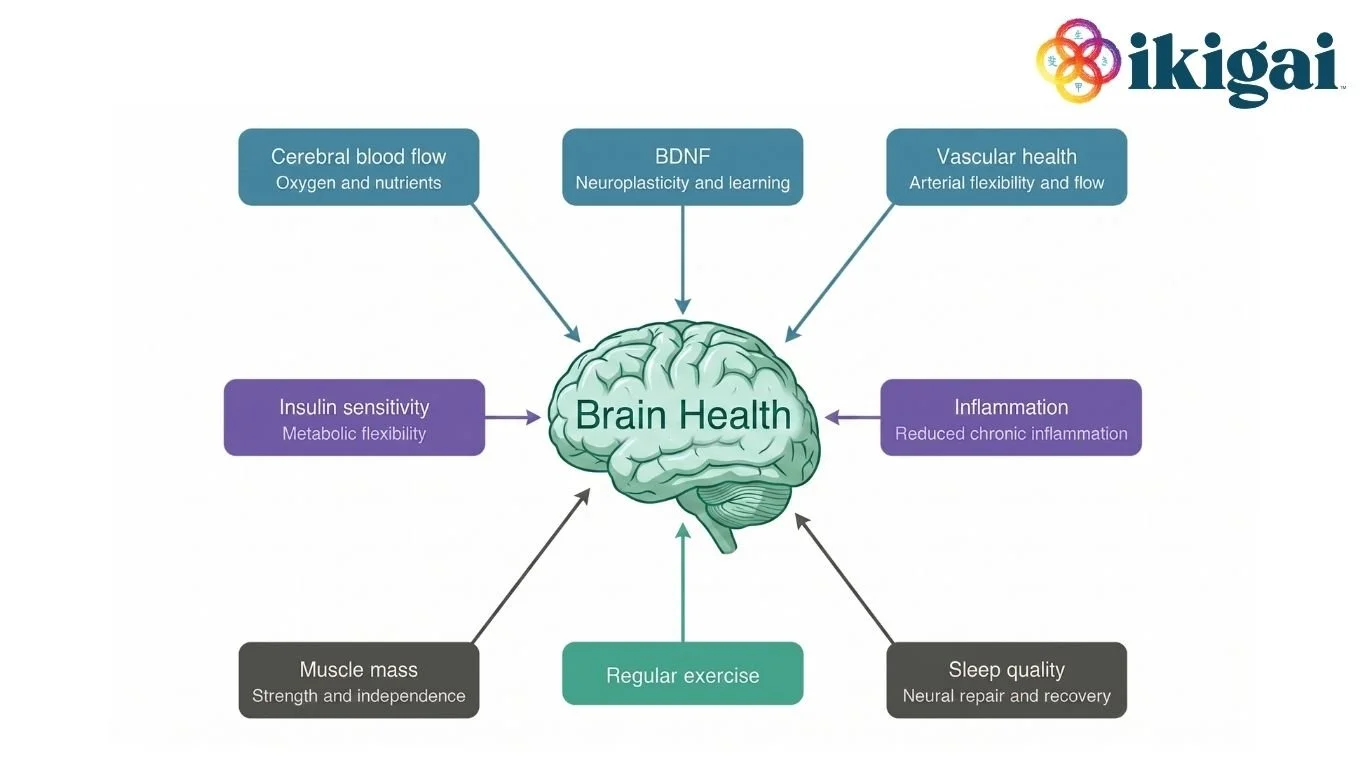
The major factors that influence brain health.
How Does Exercise Change Brain Biology?
The effects are remarkably broad. Exercise increases blood flow to the brain, helping deliver oxygen and nutrients to brain tissue over time. It also stimulates signaling pathways involved in neuroplasticity — the brain's ability to adapt, strengthen connections, and form new pathways. In practical terms, movement helps the brain remain more adaptable and resilient with aging.
Exercise also improves insulin sensitivity and metabolic flexibility, both of which appear increasingly important in long-term cognitive health. In our last article on insulin resistance and brain aging, we discussed how insulin resistance may contribute to brain aging decades before symptoms emerge. Physical activity is one of the most effective interventions we have for improving that physiology.
At the same time, regular movement helps reduce chronic inflammation, improve sleep quality, lower blood pressure, support mood regulation, and preserve muscle mass — all factors associated with healthier cognitive aging. This is one reason we rarely think about brain health as a single-organ problem at Ikigai. The brain often reflects the health of the broader system.
What Is BDNF and Why Does It Matter for the Brain?
One of the most discussed connections between exercise and brain health involves a protein called brain-derived neurotrophic factor, or BDNF. BDNF is often described as "fertilizer" for the brain because it helps support neuronal growth, survival, repair, and communication between brain cells. It also appears deeply involved in learning, memory formation, and neuroplasticity.
Exercise — particularly aerobic exercise — appears to increase BDNF signaling. Researchers believe this may be one reason physically active individuals often demonstrate better memory performance, improved executive function, and healthier cognitive aging trajectories over time.
Importantly, BDNF is probably not the entire story. The brain responds to exercise through multiple overlapping physiologic changes involving blood flow, inflammation, metabolic health, stress regulation, sleep quality, vascular function, and mitochondrial health. BDNF is one important piece of a much larger system.
This is also why we generally do not focus on measuring BDNF levels clinically at Ikigai. The science around blood testing remains limited, and the goal is not to chase a single biomarker. The goal is to consistently engage in behaviors known to support healthy brain physiology.
Aerobic Fitness, VO₂ Max, and Brain Aging
One of the most compelling areas of research involves cardiorespiratory fitness — often measured through VO₂ max testing. Higher aerobic fitness levels are consistently associated with lower rates of dementia and cognitive decline later in life, and that relationship appears dose-dependent: people with better fitness tend to have lower risk.
Importantly, aerobic exercise does not appear to help only because it lowers cardiovascular disease risk. Researchers increasingly believe aerobic training may directly influence brain structure and resilience itself. Several studies have shown that physically active adults maintain larger hippocampal volumes over time. The hippocampus is deeply involved in memory formation and is one of the earliest regions affected in Alzheimer's disease.
In one well-known randomized trial published in the Proceedings of the National Academy of Sciences, older adults who participated in a year-long aerobic exercise program increased hippocampal volume by approximately 2%, effectively offsetting some age-related volume loss during the study period while also improving memory performance. Other research has shown that higher levels of midlife cardiorespiratory fitness are associated with roughly 40% lower dementia risk decades later.
Not all randomized trials have shown broad cognitive improvement over short timeframes, which may reflect the reality that many of the protective effects of exercise likely accumulate across years and decades rather than months.
Aerobic training also appears particularly important for cerebral blood flow, vascular flexibility, mitochondrial function, insulin sensitivity, metabolic flexibility, brain energy utilization, and neuroplasticity. In many ways, aerobic exercise may provide the metabolic and vascular foundation for healthier brain aging.
At Ikigai, this is part of why we care so much about aerobic fitness, physical capacity, and long-term movement sustainability. VO₂ max is not just a performance metric. It is also becoming a meaningful marker of long-term resilience and survival.
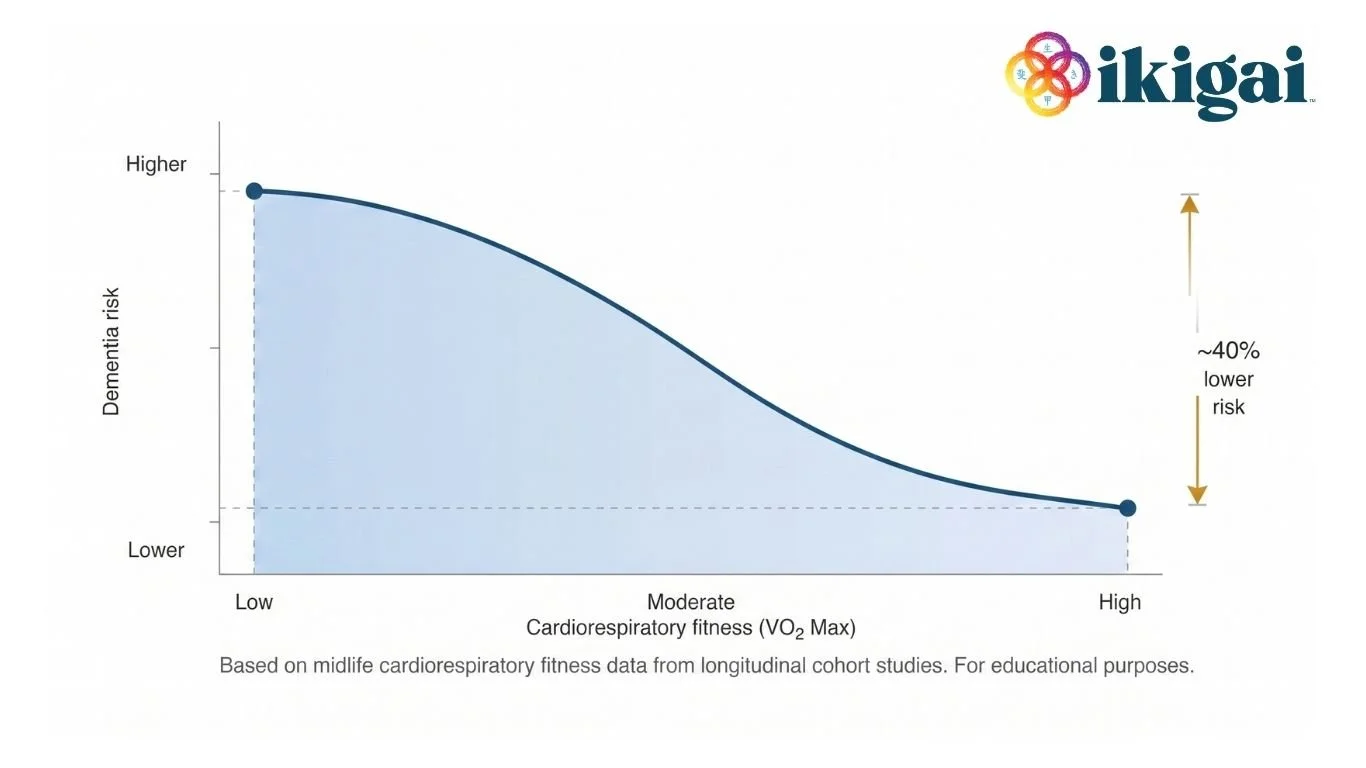
VO2 Max correlation on dementia risk
Does Strength Training Protect Cognitive Health?
When people think about exercise and the brain, they often picture walking, jogging, or cycling. But muscle health may be just as important.
Emerging research continues to show strong associations between strength, lean mass, balance, mobility, and cognitive outcomes later in life. Lower grip strength, slower gait speed, muscle loss, and reduced physical function are all associated with increased dementia risk and poorer aging trajectories.
Resistance training likely supports the brain through several overlapping mechanisms:
Preserving insulin sensitivity and glucose disposal
Maintaining lean muscle mass
Reducing frailty risk
Supporting hormonal signaling and communication between muscle and other organs
Improving stability and mobility
Preserving independence with aging
Some evidence suggests resistance training may be particularly helpful for executive function and processing speed, while aerobic exercise may exert stronger effects on memory-related pathways and hippocampal health. The reality is that different forms of exercise likely support the brain through different but overlapping mechanisms.
The relationship also appears bidirectional. As the brain declines, physical capacity often declines with it. But physical decline may also accelerate brain aging through reduced activity, insulin resistance, inflammation, vascular dysfunction, falls, social withdrawal, and loss of independence.
This is one reason we place such a strong emphasis on resistance training and movement quality in longevity medicine. Strength is not just about aesthetics or athletic performance. It is part of preserving autonomy.
Does Exercise Intensity Matter for Brain Health?
Higher-intensity exercise likely plays an important role as well. Some studies suggest vigorous exercise may produce larger acute increases in BDNF compared to lower-intensity efforts, while also improving VO₂ max, metabolic flexibility, cardiovascular performance, and physiologic resilience.
At the same time, the long-term cognitive benefits of high-intensity versus moderate-intensity exercise remain an active area of research, and no single modality has clearly emerged as universally superior. That said, we generally want patients performing at least some higher-intensity work throughout the week if medically appropriate.
The goal is not chronic exhaustion or relentless intensity. The goal is maintaining resilience and preserving physical capacity with aging. Brief periods of higher-intensity effort appear to challenge the cardiovascular system, muscles, mitochondria, and brain differently than lower-intensity training alone.
This is where nuance matters. More is not always better, and excessive training combined with poor recovery, inadequate sleep, under-fueling, high stress, or persistent overreaching may ultimately become counterproductive for both physical and cognitive health.
From a brain health standpoint, sustainable training likely matters more than extreme training. The healthiest long-term pattern for most people is probably a balanced approach that combines aerobic conditioning, strength training, recovery, mobility, and some amount of appropriately dosed higher-intensity work within a program that remains enjoyable and sustainable.
The Brain and Body Age Together
One of the more overlooked aspects of brain health is that cognitive decline and physical decline often travel together. Loss of mobility increases isolation. Frailty increases dependence. Falls increase hospitalization risk, and hospitalization itself can increase cognitive vulnerability in older adults.
As we age, physical capacity becomes deeply connected to quality of life, confidence, and independence. This is one reason we think about exercise as more than a prevention strategy for disease. It is also preparation for aging.
At Ikigai, we routinely assess aerobic fitness, strength, stability, balance, and movement patterns because these systems often provide an early window into long-term resilience. The goal is not simply to extend lifespan. It is to preserve the ability to fully participate in life for as long as possible.
How We Think About Exercise for Brain Health at Ikigai
We generally encourage patients to think about movement through several lenses:
Aerobic conditioning — building and maintaining cardiovascular fitness and VO₂ max
Strength and lean muscle preservation — resistance training as metabolic and neurological medicine
Stability and fall prevention — balance, coordination, and mobility with aging
Metabolic health — using exercise to improve insulin sensitivity and glucose regulation
Stress regulation and recovery — movement as a tool for nervous system resilience
Long-term sustainability — because consistency matters more than intensity
For most people, the ideal program is not extreme. It is durable.
That often includes a combination of Zone 2 aerobic work — sustained moderate-intensity exercise where you can still hold a conversation — resistance training, daily movement, mobility work, recovery, and some higher-intensity exercise layered in appropriately over time.
Because the protective effects of exercise on the brain likely accumulate across years and decades, consistency matters far more than perfection. By the time memory problems appear, the underlying biology has often been evolving quietly for years.
Movement is one of the ways we push back early.
Take Control of Your Brain's Future
Exercise is one of the most powerful and accessible tools we have for long-term cognitive health — but knowing how to structure it for your biology, fitness level, and goals takes precision. At Ikigai, we assess aerobic capacity, muscle health, metabolic function, and movement quality as part of a comprehensive brain health strategy.
Schedule a Brain Health Consultation — Build a personalized exercise and longevity strategy grounded in your data.
Join the Ikigai Newsletter — Get the full Brain Health Series and actionable longevity insights delivered to your inbox.
Explore Our Programs — See how we integrate VO₂ max testing, strength assessment, and metabolic tracking into your care.
Recommended Reading
Insulin Resistance and Brain Aging: The Metabolic Link to Dementia — How chronic metabolic dysfunction creates a brain energy gap decades before symptoms appear.
VO₂ Max: Your Ultimate Longevity Predictor — Why cardiorespiratory fitness is one of the strongest predictors of survival and cognitive health.
How To Track Brain Health (Before It Slips) — The three-domain framework Ikigai uses to measure brain health before symptoms emerge.
Dementia Risk Factors: What You Can Control — A guide to the 14 modifiable risk factors linked to nearly half of all dementia cases.
Movement as Medicine for the Heart — How exercise protects vascular health through nitric oxide, shear stress, and VO₂ max.
Understanding Lactate – Your Real-Time Metabolic Health Biomarker — How we use lactate testing to find your precise Zone 2 threshold.
A Look Ahead
Next in the Brain Health Series, we'll explore sleep — one of the most underestimated and most actionable drivers of cognitive aging. What happens in the brain during sleep, why disruption compounds over time, and what we actually measure and address at Ikigai.
