
Cancer Screening: Why Earlier Can Be Better — but More Is Not Always Better
Finding cancer earlier can change everything — but finding more isn't automatically better. Cancer screening can miss disease, raise false alarms, or detect a real cancer that would never have caused harm. The goal of a thoughtful screening strategy isn't to look as often or as aggressively as possible. It's to find the cancers that matter, early enough to change the outcome, while minimizing the harm that comes from looking.
What's in this post?
Why stage matters: The basic promise screening is trying to keep.
Earlier isn't the same as better: What lead-time bias actually means.
Sometimes screening finds what never needed finding: Overdiagnosis, explained.
Then there are false positives: What happens after a test raises an alarm.
More sensitive isn't automatically better: Why finding more isn't the whole story.
Guidelines are a starting point: Why population advice isn't a personal strategy.
Sometimes earlier really is better: Where screening delivers on its promise.
Smarter, not less, screening: Why the answer isn't to stop looking.
Screening is not an event: Why follow-through matters as much as the test.
The Ikigai view: How we balance aggression with judgment.
Cancer screening rests on an idea that feels almost self-evident: if cancer is present, finding it earlier should be better. Often, it is. A cancer discovered while it's still small and confined to one organ may be easier to remove, easier to treat, and far less likely to have spread. In some cancers, finding disease before symptoms develop can dramatically change what happens next. And in a few important cases, screening can do something even better than finding cancer early: it can identify and remove precancerous tissue before cancer develops at all.
That's why screening is one of the most powerful tools we have against cancer. But there's an important wrinkle: looking harder does not automatically make us healthier. Every screening test has limitations. Tests can miss cancer. They can find something that looks concerning but turns out to be harmless. They can uncover abnormalities unrelated to cancer that lead to more scans, procedures, and anxiety. And occasionally, screening finds a real cancer that would never have threatened a person's health during their lifetime.
So the goal of a thoughtful cancer screening program is not to perform every available test as often as possible. The goal is to find the cancers that matter, early enough to change the outcome, while minimizing the harm created by looking. That distinction is central to how we think about cancer screening at Ikigai.
Why Stage Matters
Cancer is not one disease. It's hundreds of diseases with different biology, different rates of growth, and different patterns of spread. But across many cancers, one principle holds: the extent of disease when it's discovered matters enormously. A small cancer confined to its site of origin is a very different clinical problem from the same cancer after it has spread to distant organs.
Consider colon cancer. A localized tumor may sometimes be removed surgically with curative intent. Once colorectal cancer has spread widely, treatment typically becomes much more complicated. Breast cancer, melanoma, kidney cancer, and many other cancers show similar patterns. Earlier-stage disease frequently creates more treatment options and a greater opportunity for cure.
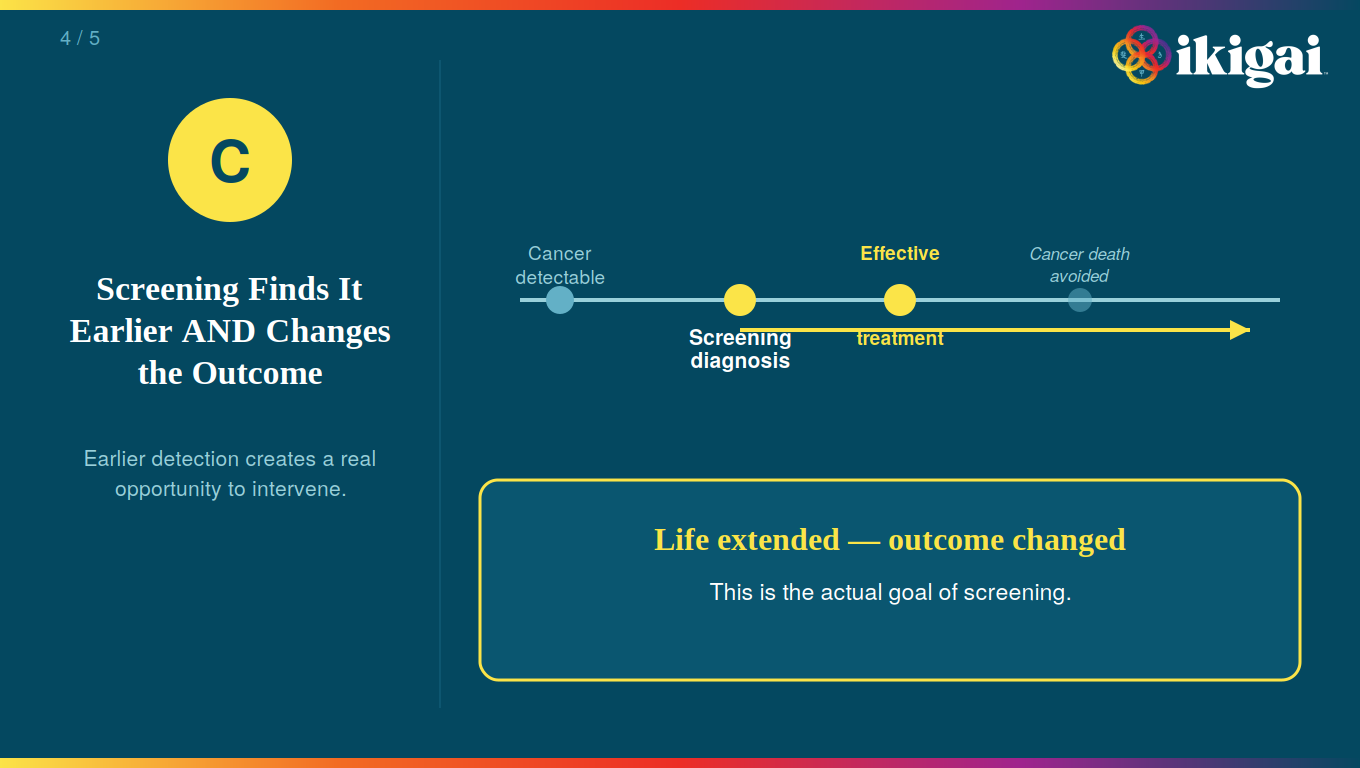
This is the basic promise of screening: create an opportunity to discover cancer during a window when a person feels perfectly well but the disease is already detectable and potentially more treatable. Screening therefore lives in the space between two moments — the point when a cancer becomes biologically detectable and the point when that cancer would eventually produce symptoms. Sometimes that interval is short. Sometimes it lasts years. Screening tries to use that window to our advantage.
And it works. Mammography, colorectal cancer screening, cervical cancer screening, and low-dose CT in appropriately selected people at elevated risk for lung cancer are examples of screening strategies supported by evidence that extends beyond simply finding more cancers. Current national guidelines recommend these tests because, in the right populations and at the right intervals, their benefits outweigh their harms. But that last phrase matters: in the right populations and at the right intervals.
Earlier Diagnosis Is Not Quite the Same Thing as Better Diagnosis
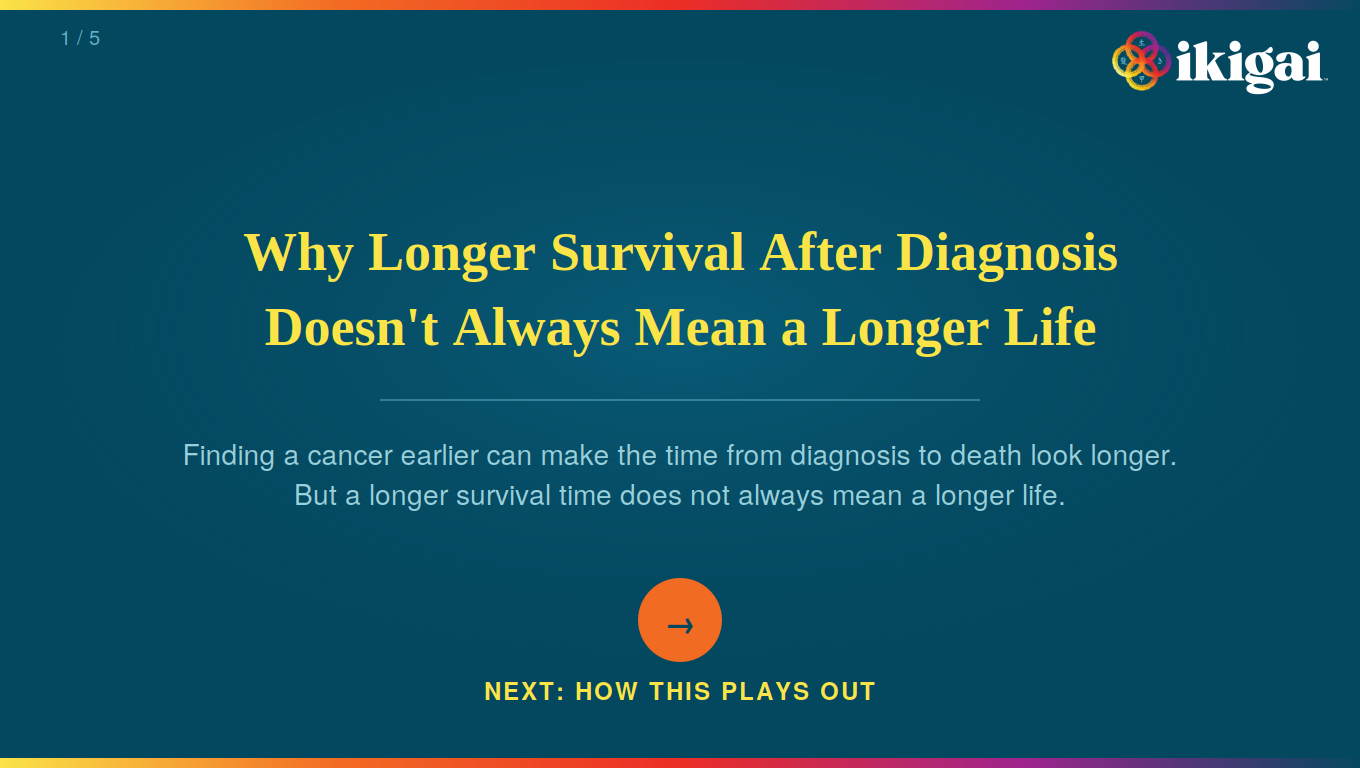
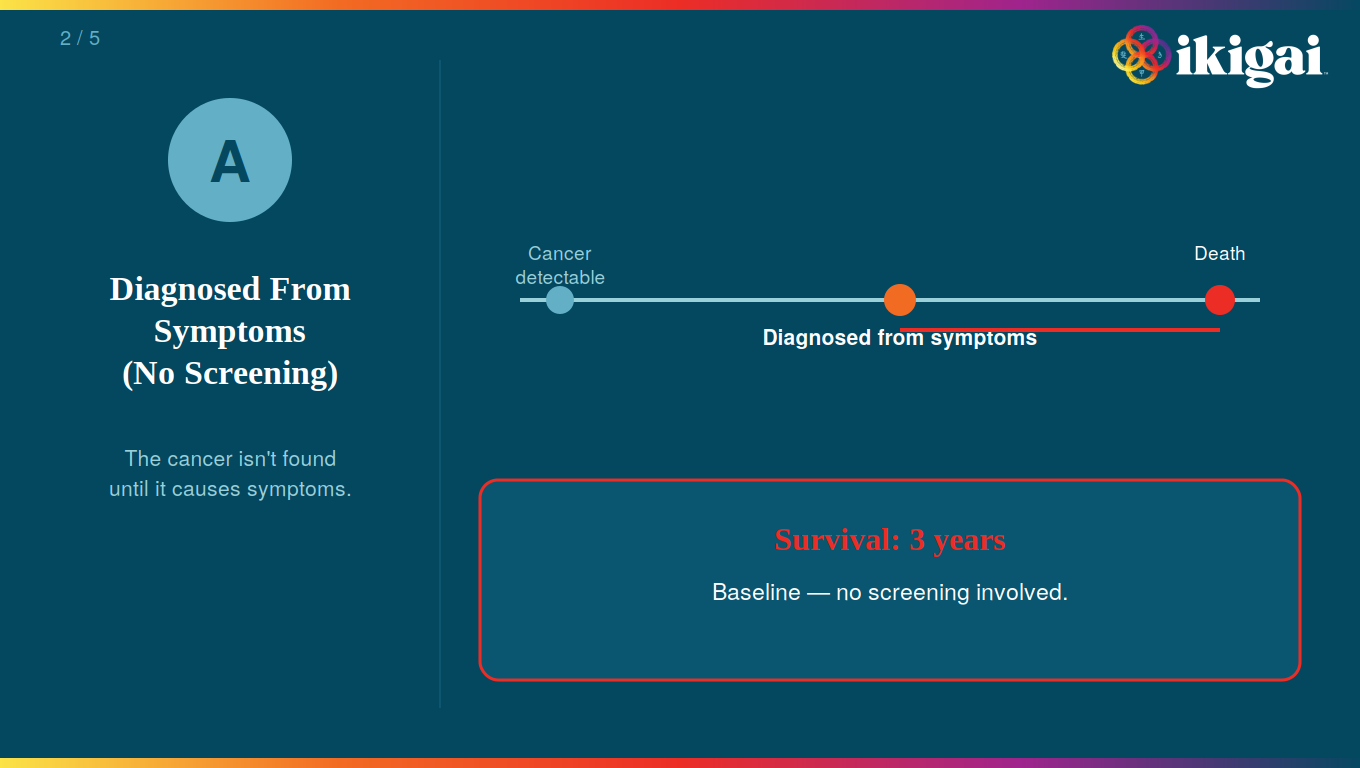
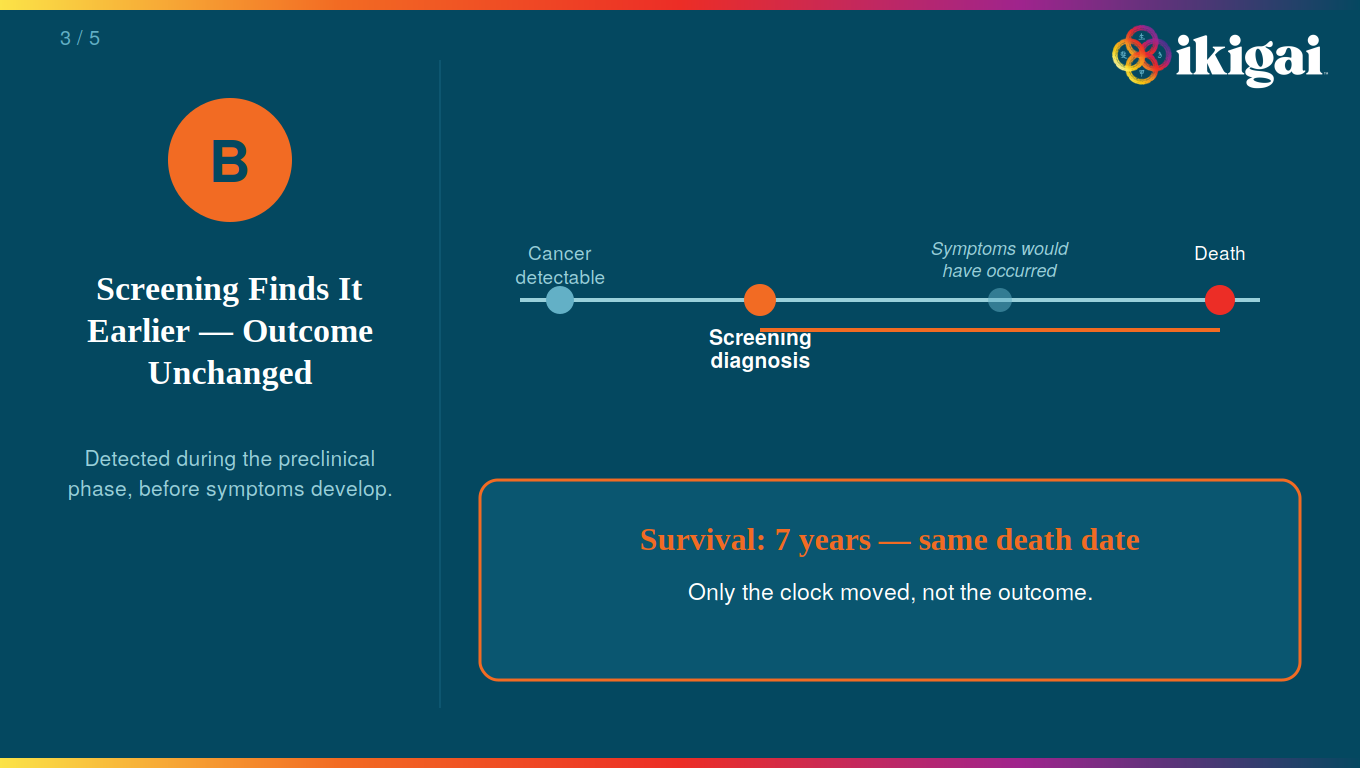
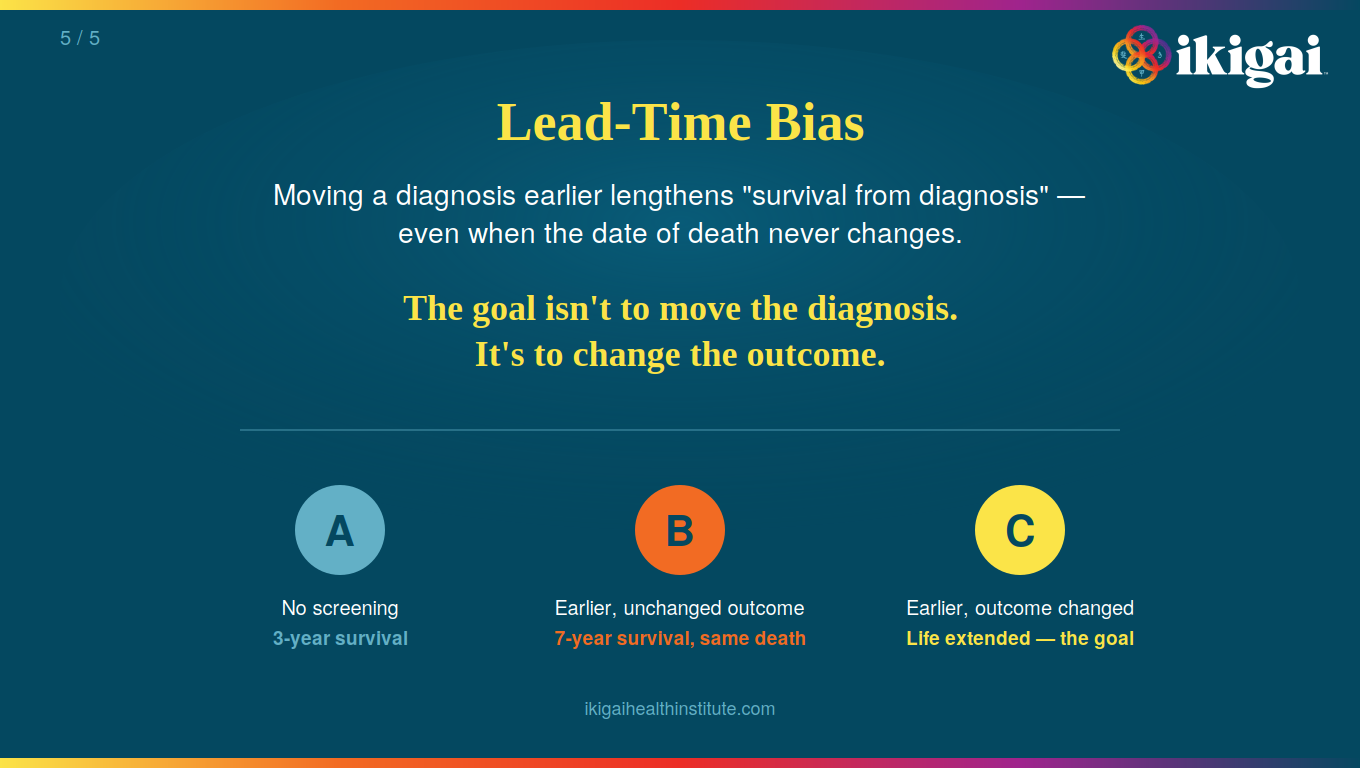
This is where cancer screening becomes more interesting. Imagine two people who develop exactly the same cancer. The first person is diagnosed at age 67 after developing symptoms and dies from the cancer at age 70. From the time of diagnosis, that person survived three years. Now imagine that screening discovers the exact same cancer several years earlier. Treatment does not alter its biological course, and that person still dies at age 70. Their measured survival after diagnosis has increased, but the person did not actually live any longer.
Researchers call this lead-time bias. It's one reason scientists cannot simply look at how long people survive after a screening-detected cancer and conclude that screening saved their lives: the clock started earlier. The distinction sounds academic, but it's extremely important. Good screening programs should ultimately reduce the burden of advanced cancer, reduce cancer deaths, prevent cancer, or meaningfully improve outcomes — not simply move the date of diagnosis earlier.
This is also why the phrase "early detection saves lives," while directionally useful, deserves a little nuance. The more accurate version is that early detection can save lives when detecting a particular cancer earlier creates an opportunity to change its outcome. That's the target.
Sometimes Screening Finds Something That Never Needed to Be Found
There's another complication. Not every cancer behaves the way we instinctively imagine cancer behaving. We tend to think of cancer as a relentless process: one malignant cell becomes two, then four, then thousands, then millions, eventually invading surrounding tissue and spreading throughout the body unless we intervene. Some cancers behave exactly that way. Others do not.
Certain cancers grow extraordinarily slowly. Some may stop growing. Some cancers discovered late in life would never become large enough to cause symptoms during that person's lifetime. Autopsy studies make this idea surprisingly tangible: researchers have found microscopic prostate cancers in men who died from completely unrelated causes and never knew the cancers were there, with these unsuspected cancers becoming increasingly common with age.
That doesn't mean a diagnosed prostate cancer — or any cancer — should simply be ignored. Rather, it illustrates how enormously cancers can differ in their biology. Some abnormalities that meet the pathological definition of cancer may grow so slowly that they would never have affected a person's health, while others can be aggressive and life-threatening. Once a cancer is identified, understanding its biology, stage, and appropriate treatment or surveillance requires careful clinical evaluation.
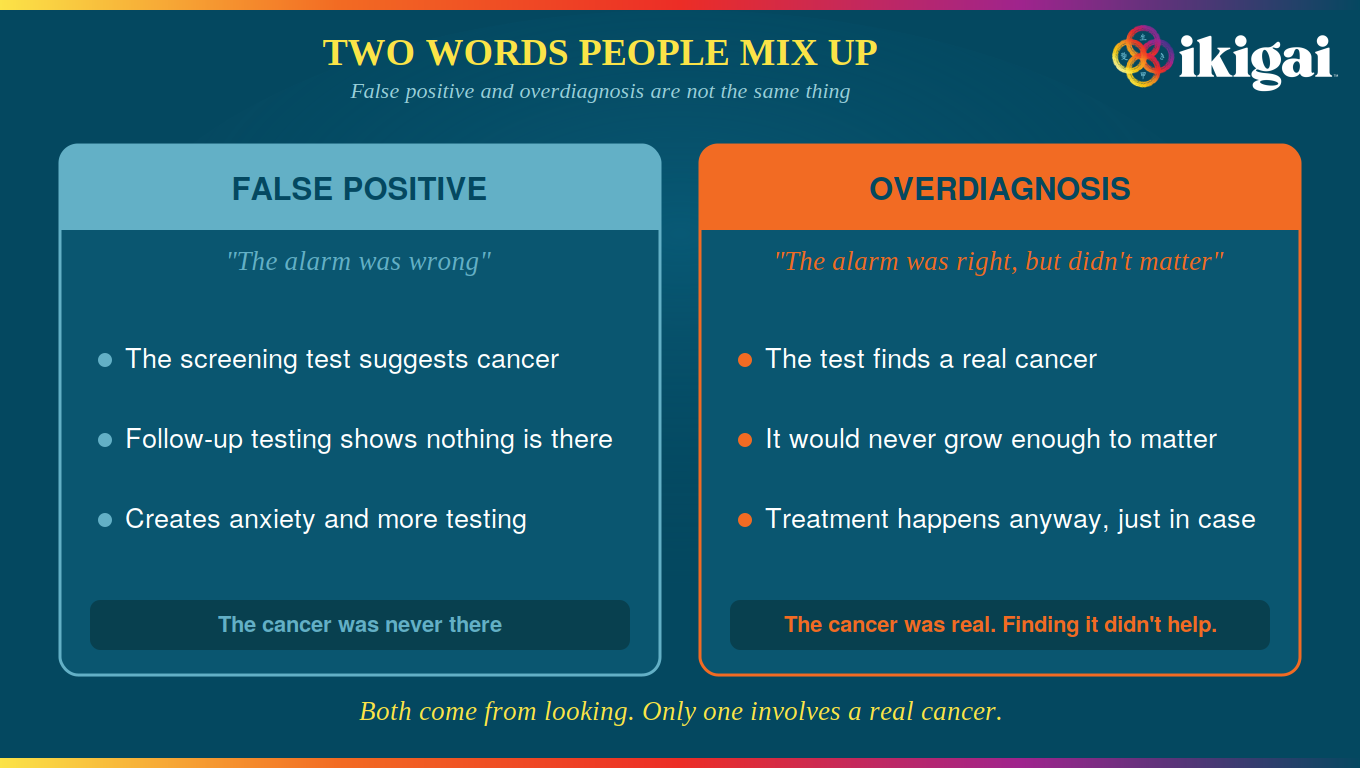
When screening discovers a true cancer that would never have caused illness or death, it's called overdiagnosis. This is very different from a false positive. With a false positive, the screening test raises an alarm but cancer is ultimately not present. With overdiagnosis, the cancer is real. The problem is that finding it does not help the patient.
And once we give something the name cancer, doing nothing can become psychologically and medically difficult. A biopsy may follow, then surgery, and sometimes radiation or medication. There may be complications, costs, and months of worry. A person can become a "cancer survivor" after treatment for a cancer that was biologically destined never to harm them. Importantly, when careful observation rather than immediate treatment is appropriate for a particular cancer, that decision is itself a medical strategy — active surveillance — not an invitation to dismiss the diagnosis.
This is one of the central paradoxes of screening: a technology can become extraordinarily good at finding cancer without necessarily becoming equally good at improving health. The distinction is especially important as imaging becomes more sensitive, blood-based cancer detection evolves, and artificial intelligence becomes increasingly capable of recognizing abnormalities that humans previously could not see. Our ability to find things is advancing rapidly, but our ability to know what every finding means does not always advance at the same speed.
Then There Are False Positives
Most people who undergo cancer screening do not have cancer, and that simple fact has enormous implications. Suppose a screening test identifies something suspicious. That finding may represent cancer, but it may also be a benign nodule, cyst, scar, inflammatory change, unusual anatomy, or simply an imperfect measurement.
The screening test has done its job: it has identified something that deserves another look. But now the diagnostic process begins. That may mean another mammogram, ultrasound, MRI, CT scan, blood test, specialist consultation, endoscopy, or biopsy. Most of the time, this process eventually brings reassurance. Occasionally, it discovers something important. But the path between those two points is not always trivial.
False-positive results can create anxiety. Follow-up imaging exposes people to additional testing and sometimes additional radiation. Biopsies carry small but real risks of bleeding, infection, and other complications. Colonoscopy can rarely cause bleeding or perforation. And incidental findings can start entirely new chains of investigation. This doesn't mean we should avoid screening. It means screening has a downstream footprint, and a good screening strategy considers that footprint before ordering the first test.
More Sensitive Is Not Automatically Better
We naturally gravitate toward tests described as more sensitive. If Test A finds 70 percent of cancers and Test B finds 90 percent, Test B sounds obviously superior. But sensitivity is only part of the story. What happens to all the people who do not have cancer? How often does the test falsely suggest that cancer might be present? How many people will need additional imaging or undergo biopsies? How many cancers detected would actually have become dangerous? Does finding these additional cancers reduce advanced disease or cancer mortality? And does the benefit justify the physical, psychological, and financial consequences of investigating everything else the test finds?
These questions become increasingly important as we move beyond traditional organ-specific screening. A mammogram is looking primarily for breast cancer. A colonoscopy examines the colon and rectum. A low-dose chest CT is designed to identify abnormalities that may represent lung cancer in people at increased risk. Whole-body imaging and multicancer detection technologies, by contrast, cast a much wider net.
That creates tremendous potential, but it also creates more opportunities to find things: a tiny kidney lesion, a lung nodule, a thyroid nodule, a liver cyst, an unusual area in a bone, or a blood signal suggesting that a cancer might exist somewhere in the body. Some of those findings will matter enormously. Many will not. The clinical challenge is telling the difference.
Guidelines Are a Starting Point — Not a Personalized Cancer Strategy
National cancer screening guidelines are extraordinarily valuable. They synthesize large amounts of evidence and establish screening approaches that offer a favorable balance of benefit and harm for populations. But populations are not individuals. A recommendation designed for millions of average-risk adults cannot incorporate every detail of one person's family history, genetics, prior polyps, breast density, tobacco exposure, occupational exposures, previous cancers, medications, inflammatory diseases, or decades of environmental exposure.
That distinction is why the phrase average risk matters so much in screening guidelines. For example, current recommendations support colorectal cancer screening beginning at age 45 for average-risk adults. But someone with a strong family history, an inherited cancer syndrome, inflammatory bowel disease, or certain previous polyps may need a substantially different strategy.
The same principle applies across cancer types. A woman with a pathogenic BRCA variant is not simply an average-risk woman who happens to have an interesting genetic result; her cancer surveillance strategy changes. A person with substantial tobacco exposure may qualify for low-dose CT lung cancer screening when someone without that exposure would not. A family history of pancreatic cancer may be irrelevant to routine pancreatic screening for one person and enormously important for another, depending on the number of affected relatives, their ages at diagnosis, and whether an inherited cancer-predisposition mutation is present.
Screening therefore should not begin with a menu of tests. It should begin with risk. That was the focus of our previous Ikigai Insights: understanding what we know, what we can reasonably learn, and what remains unknowable about an individual's cancer risk. Once we understand that landscape, we can make better decisions about where looking earlier — or looking differently — may make sense.
Sometimes Earlier Really Is Better
None of these cautions change the fundamental reason we care so much about early detection. Cancer is projected to be diagnosed in more than two million Americans in 2026. Despite enormous progress in prevention and treatment, more than 600,000 Americans are expected to die from cancer this year. The opportunity is not simply to diagnose more of those cancers. It is to shift consequential cancers toward a point in their natural history when we have a better chance to intervene.
Sometimes that means finding precancer. A colonoscopy can identify and remove certain polyps before they become colorectal cancer. Cervical screening can identify precancerous changes that can be treated before invasive cervical cancer develops. That's better than early detection; it's cancer prevention.
Sometimes the opportunity is stage shift: finding an invasive cancer before it has spread. And sometimes earlier detection gives us more options. Surgery may be possible. Treatment may be less extensive. The chance of cure may be greater. This is why we believe the future of cancer screening will involve more — not less — ability to detect disease before symptoms develop. But better technology needs to be paired with better judgment.
The Answer Is Not Less Screening. It's Smarter Screening.
It would be easy to read about false positives, overdiagnosis, and incidental findings and reach the opposite extreme: perhaps we should simply stick to the minimum recommended screening and stop looking for trouble. We don't think that's the right conclusion either.
Traditional guideline-based screening leaves substantial blind spots. Only a limited number of cancers currently have broadly recommended population screening programs. Many serious cancers — including pancreatic, ovarian, and brain cancers in average-risk populations — do not have routine screening recommendations for the general public. That doesn't mean every healthy person should receive every available cancer test. It means we need to acknowledge the gap.
At Ikigai, our approach is to build cancer screening as a layered system. Guideline-recommended screening forms the foundation. We then consider the individual: age, sex, family history, personal history, genetics, exposures, and other meaningful risk factors. In selected situations, additional imaging, specialist surveillance, or emerging technologies may reasonably add information.
But every additional layer should answer a question. What are we looking for, and why does this person have enough risk to justify looking? How likely is the test to find something meaningful? What are we going to do with an abnormal result? And perhaps most importantly, is finding this disease earlier reasonably likely to improve the person's outcome? Those questions keep aggressive screening from becoming indiscriminate screening.
Screening Is Not an Event
There's one final problem with thinking about cancer screening simply as a collection of tests: a test is only one moment. Imagine a scan finds a small pulmonary nodule that's unlikely to be cancer but needs another scan in 12 months. The initial test has accomplished very little if nobody remembers the follow-up. A colonoscopy identifies a polyp that changes the interval before the next colonoscopy; that recommendation matters years later. A family history changes because a sibling is diagnosed with cancer at age 52. A new genetic test becomes available. A mammogram reveals dense breast tissue. A blood-based screening test produces an abnormal signal requiring diagnostic imaging. A patient ages into eligibility for lung cancer screening — or eventually reaches an age when the balance of benefit and harm shifts in the other direction.
Cancer risk is dynamic, so screening needs to be dynamic too. That's why we think of cancer screening as a longitudinal system rather than an annual event: assess risk, screen appropriately, track findings, complete follow-up, and periodically reassess the strategy. As we use broader and more sensitive screening technologies, the system surrounding the test becomes even more important. Someone has to interpret what was found, determine whether it matters, decide what should happen next, and make sure that recommended follow-up actually occurs.
A screening test without that infrastructure can create information without creating better health. The sophistication is not in ordering the most tests. It is in knowing what deserves to be done next — and making sure it gets done.
The Ikigai View
We are intentionally aggressive about identifying disease early, but aggressive does not mean indiscriminate. We want to use the expanding tools of modern medicine — better imaging, genetics, biomarkers, multicancer detection, and eventually increasingly sophisticated artificial intelligence — to move meaningful cancer diagnoses earlier whenever the evidence and an individual's risk justify doing so.
At the same time, we have to respect what those technologies cannot yet tell us. A tiny abnormality is not automatically dangerous. A positive screening test is not a cancer diagnosis. A negative screening test does not guarantee that cancer is absent. And finding more abnormalities does not necessarily mean we're improving health.
The objective is not to produce the cleanest possible scan or to prove that absolutely nothing abnormal exists in the body. Human beings accumulate abnormalities as we age, and if our technology becomes sensitive enough, virtually everyone will have something to find. The objective is to identify disease that matters while there's still time to do something meaningful about it.
Doing that well requires technology, evidence, and judgment. Earlier can be better, but more is not always better. The art — and science — of modern cancer screening is knowing the difference.
Take the Next Step
Wondering whether your own screening plan strikes the right balance — thorough enough to matter, without chasing every abnormality your body accumulates with age? That's exactly the judgment call we make with every patient.
Schedule a Consultation — Build a screening strategy calibrated to your actual risk, not just a checklist.
Join the Ikigai Newsletter — Follow this series as we publish it over the coming months.
Explore Our Programs — See how Ikigai builds smarter screening into a complete longevity strategy.
Recommended Reading
Cancer Risk Is Personal: Building Your Cancer Risk Profile — The previous post in this series, on why screening should start with individual risk.
Cancer Screening Today: What We Find, What We Miss — The series opener, on the gap between what we screen for and what causes most cancer deaths.
Breast Cancer: Why Early Detection Changes Everything — A closer look at one of the cancers where stage-at-diagnosis matters most.
References
The information in this post is for educational purposes only and is not intended as medical advice. Screening decisions should always be made with a physician who knows your personal and family history.
