
Cancer Risk Is Personal: Building Your Cancer Risk Profile
You don't have one "cancer risk" — you have a different risk for every cancer type, shaped by your age, family history, genetics, and personal exposures. A single label like "average risk" or "high risk" misses most of what actually matters for an individual. Building a real cancer risk profile means gathering the clues that are easy to see, the ones hidden in family history, and even the ones science hasn't caught up to yet — then updating that picture for the rest of your life.
What's in this post?
There is no single "cancer risk": Why you have a risk profile, not a risk score.
Some clues are easy to see: Age, personal history, and exposures that announce themselves.
Your family history is more than a checkbox: Why "yes" or "no" isn't a good enough answer.
Genes are only part of the story: What epigenetics adds to the picture.
And some clues are hidden: The exposures nobody knew to ask about.
The known, the knowable, and the unknown: A more honest way to think about risk.
Risk is not destiny: Why probability isn't the same as fate.
A risk profile should never be finished: Why this is a living document, not a one-time form.
Better risk information should lead to better decisions: What this series covers next.
In the first article of this series, we looked at cancer screening from 30,000 feet. We celebrated what modern screening does remarkably well, but we also confronted its limitations. Roughly 70% of cancers diagnosed — and roughly 70% of cancer deaths — come from cancers for which there is no guideline-recommended population screening strategy.
That raises an obvious question: should we be looking for more? Maybe. But before deciding which tests to order, when to start, how often to repeat them, or whether to venture beyond established screening, we think there's a more important question to ask first: who are we screening?
Cancer risk is personal. But personal does not mean perfectly knowable. Each of us arrives at this question with a different story. We are different ages. We have different biology, different families, and different medical histories. We have lived in different places, worked different jobs, eaten different foods, and accumulated different exposures. Some of us smoked. Some drank heavily. Some spent decades in the sun. Some have already had a cancer, a precancerous lesion, or an advanced colon polyp. Some carry an inherited genetic variant that substantially increases the risk of a particular cancer. And some of the most important parts of our story may be things we don't yet know.
The goal isn't to know your risk with certainty. It's to understand it well enough to make better decisions.
There Is No Single "Cancer Risk"
We often talk about cancer risk as though it were one thing: low risk, average risk, or high risk. Those categories are useful, particularly when guidelines have to make recommendations for millions of people. They become less satisfying when we're talking about one person. You don't really have one cancer risk. You have a risk of colorectal cancer, a risk of melanoma, a risk of pancreatic cancer, a risk of lung cancer, and, depending on your biology, a risk of breast, ovarian, or prostate cancer. Different forces influence each of those risks.
Imagine a 55-year-old woman whose mother developed breast cancer at 42, whose father developed pancreatic cancer at 61, who had an advanced colon polyp removed at 50, and who smoked for ten years in her twenties. Calling her simply "average risk" or "high risk" misses much of what matters. Her history contains several different clues, potentially pointing in several different directions.
The purpose of a personal cancer risk profile is to assemble those clues. Some will meaningfully change what we do. Others may shift risk only slightly. Some may ultimately prove irrelevant. And there will always be pieces we don't have. The objective isn't to manufacture certainty from imperfect information. It is to build the best map we can.
Some Clues Are Easy to See
Age is one of the most powerful cancer risk factors we have. The median age at cancer diagnosis in the United States is about 66. Cancer becomes more common as we get older because our cells have had more time to accumulate the changes that can eventually allow a cancer to develop. Biological sex matters, as does personal medical history. A previous cancer, certain types of colon polyps, precancerous changes, and other findings can alter what we should pay attention to in the future.
Some exposures announce themselves pretty clearly, too. If you smoked a pack of cigarettes a day for 30 years, that matters. If you routinely drink 20 alcoholic drinks a week, that matters. Decades of substantial ultraviolet exposure matter. Certain occupational exposures matter. These are pieces of a person's history that can help us understand cancer risk and, in some cases, change what we do about it.
Importantly, identifying a modifiable risk isn't about assigning blame for a future cancer. Cancer is far too complicated for that. It's about finding something useful. If an exposure or behavior is increasing risk and we can change it, that gives us an opportunity to act before there's anything to screen for. We'll spend much more time on cancer risk reduction later in this series, including what we know about the modifiable factors that can meaningfully influence cancer risk. For now, the important point is simply that a thoughtful risk profile includes not only what you inherited, but also what has happened to you and how you have lived.
Your Family History Is More Than a Checkbox
Most medical forms ask some version of: "family history of cancer?" The answer matters, but a yes-or-no checkbox doesn't tell us nearly enough. Suppose your mother had breast cancer. How old was she when it was diagnosed? Was she 42 or 82? Did anyone else on that side of the family have breast cancer? What about ovarian, pancreatic, or prostate cancer? Did your father have cancer? His siblings? Your grandparents? Were there multiple cancers in one person? Has anyone in the family undergone genetic testing?
Patterns matter because a single cancer occurring late in life may tell us something very different from several related cancers appearing at unusually young ages across generations. We can see this with colorectal cancer: having one first-degree relative — a parent, sibling, or child — with colorectal cancer roughly doubles your own risk, with even greater concern when that relative was diagnosed at a young age. Sometimes a family pattern is striking enough to raise suspicion for a known hereditary cancer syndrome and prompt genetic counseling or testing — the kind of conversation we build into a well-woman visit when family history points that way. In other families, the pattern may look meaningful even though today's genetic testing cannot identify a specific inherited variant that explains it.
That last point is important. Only about 5–10% of cancers are attributable to strongly inherited genetic changes. We know a great deal about inherited cancer risk, but we do not know everything. Some cancers have well-established genetic drivers, and identifying one can substantially change screening and prevention for an individual and sometimes an entire family. But science will continue to uncover genes, combinations of genes, and other biological factors that we do not fully understand today.
A negative genetic test therefore doesn't erase a compelling family history. Sometimes it means we looked for the inherited risks we currently know how to identify and didn't find one. Those aren't quite the same thing. Family history also changes because your family's medical history continues to happen after your physician takes your medical history. A sibling may develop pancreatic cancer next year. A parent may receive a diagnosis that changes how we interpret cancers elsewhere in the family. A relative may undergo genetic testing and discover something relevant to you. That's one reason cancer risk deserves to be revisited rather than documented once and forgotten.
Genes Are Only Part of the Story
Genetics is easy to understand conceptually: you inherit DNA from your parents, and some inherited variants can increase cancer risk. But DNA isn't operating in a sealed container. It spends a lifetime interacting with the world around it, which brings us to epigenetics. We apologize. We were doing so well without using a word that sounds like it belongs in a graduate-school seminar.
Fortunately, the concept is much easier than the name. Your DNA sequence is the genetic code you inherited. Epigenetics describes some of the ways cells regulate how that code is used — turning the activity of certain genes up or down without rewriting the DNA sequence itself. Aging, behavior, environment, and other biological influences can affect these regulatory processes.
Why does that matter here? Because the neat categories we use when talking about cancer risk — genetics over here, lifestyle over there, environment somewhere else — aren't actually so neat inside the human body. Biology reflects interactions among them over decades. An inherited susceptibility may matter differently in the presence of a particular exposure. Environmental and behavioral influences can affect cellular processes involved in cancer development. Cancer itself usually emerges after multiple biological changes accumulate over time, not because a single switch suddenly flips.
We should also be humble about what this means clinically. We cannot take an "epigenetic test" today and neatly calculate an individual's future cancer risk. The science is far more complicated than that. But epigenetics gives us a useful way to think about risk: what you inherited matters, but so does what your biology has encountered along the way.

And Some Clues Are Hidden
This is where understanding personal risk becomes harder. You can tell your physician that you smoked for 30 years because you know you smoked. You can describe your alcohol intake, your sun exposure, and the jobs you've held. But what if you were exposed to something you didn't know was there?
Real-world environmental contamination has made this painfully clear. Dark Waters told the real story of communities exposed to PFOA contamination associated with DuPont. Many people lived for years without knowing the significance of the exposure, and our scientific understanding continued to evolve long afterward. In 2023, the International Agency for Research on Cancer classified PFOA as carcinogenic to humans. The broader lesson reaches beyond this particular chemical: sometimes an exposure's medical relevance becomes clear only years later as science advances.
You cannot report an exposure you never knew you had. That doesn't mean we should assume there are hidden carcinogens everywhere or live anxiously searching for them. It means something much simpler: even an extraordinarily careful medical history has limits. Some risks are obvious. Some become visible only when someone asks the right question. Others may become apparent years later as science advances or new information emerges. And some may never be known.
Personalized medicine is not omniscient medicine.
The Known, the Knowable, and the Unknown
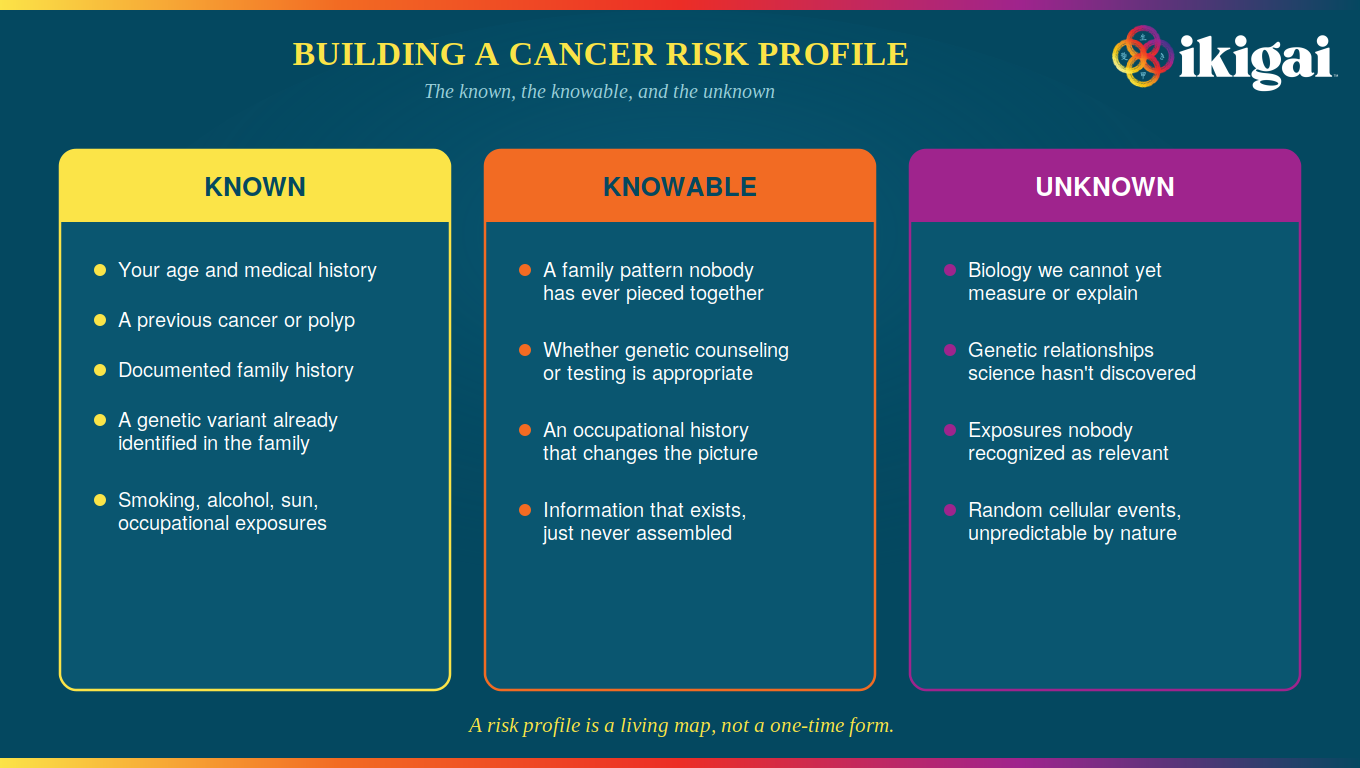
That may be the most useful way to think about a cancer risk profile. There are things we know: your age, your medical history, a previous colon polyp, 30 years of smoking, a mother diagnosed with breast cancer at 42, a pathogenic genetic variant already identified in the family.
There are things we may be able to know if we look more carefully. Perhaps nobody ever noticed that several cancers clustered on your father's side of the family. Perhaps genetic counseling reveals that testing is appropriate. Perhaps reviewing an occupational history uncovers an exposure that changes how we think about risk. Sometimes the information was there all along; nobody had assembled it.
And then there's the unknown: biology we cannot yet measure, genetic relationships science has not discovered, exposures nobody recognized, and random cellular events that could never have been predicted from a family tree, questionnaire, or blood test. The existence of that unknown shouldn't make us throw up our hands, nor should it drive us to test everyone for everything. It should make us appropriately humble about what "personalized risk" actually means. We do our best with the information available.
Risk Is Not Destiny
There's another reason to be careful with the language of risk. Risk describes probability, not fate. A person with an inherited variant associated with cancer may never develop that cancer. Someone who has exercised for decades, never smoked, drinks little alcohol, and has no meaningful family history can still develop cancer. Healthy behavior can reduce risk; it cannot eliminate it. Elevated risk deserves attention; it does not deserve panic.
This is also why cancer-risk assessment should be a conversation with your physician rather than a solo exercise in collecting risk factors from the internet. Individual pieces of information need context. A family history may or may not justify genetic testing. A prior finding may or may not change the timing of screening. An exposure may sound frightening without meaningfully changing absolute risk. And a newer test may be technically available without being the right test for you. The purpose of understanding risk is not to generate anxiety. It's to make the next decision better.
A Risk Profile Should Never Be Finished
Imagine that we build the best possible cancer risk profile for you today. We carefully review your personal and family history, genetics where appropriate, prior findings, exposures, and modifiable risks. Tomorrow starts changing it. You get older. A sibling receives a cancer diagnosis. Your next colonoscopy finds an advanced adenoma. A relative discovers a pathogenic genetic variant. We learn something new about an exposure from years ago. Medical science identifies a risk relationship we didn't understand when we first met you.
The map changes because the territory changes. And sometimes the territory was there all along — we simply get better at seeing it. That's why we think of cancer risk as a living profile rather than a one-time assessment. It should evolve as the patient, the family, and the science evolve.
Better Risk Information Should Lead to Better Decisions
Last week, we made the case that cancer screening should not simply be a checklist of tests. This is where that idea becomes personal. Understanding your risk may tell us that established screening is exactly what you need. It may tell us to start a proven screening test earlier or perform it more frequently. It may lead to genetic counseling or testing. It may uncover a modifiable risk worth addressing now. It may justify involving a specialist. In selected circumstances, it may give you and your physician a reason to discuss an emerging technology or a screening approach that isn't recommended for the average-risk population.
And sometimes, after considering all of that, it may tell us that more testing isn't likely to help. That's important. Personalization should not be a euphemism for doing more. It should mean making a better decision for the person in front of us.
Over the next several months, we are going to explore what some of those decisions look like. We'll examine the established cancer-screening playbook, when personal risk should change the rules, what genetics can and cannot tell us, and where newer approaches such as multi-cancer blood testing and whole-body imaging may — or may not — fit. The technology comes second.
The person comes first.
Cancer risk is personal. But personal does not mean perfectly knowable. We gather the obvious clues, look carefully for the less obvious ones, acknowledge what remains outside our view, and keep updating the picture as life and science move forward. The goal isn't to know your risk with certainty. It's to understand it well enough to make better decisions.
Take the Next Step
Wondering what your own cancer risk profile actually looks like — beyond a simple "average" or "high risk" label? That conversation is where we start with every new patient.
Schedule a Consultation — Build a personal cancer risk profile that goes beyond a checklist.
Join the Ikigai Newsletter — Follow this series as we publish it over the coming months.
Explore Our Programs — See how Ikigai builds personalized risk into a complete longevity strategy.
Recommended Reading
Cancer Screening Today: What We Find, What We Miss — The first post in this series, on the gap between what we screen for and what actually causes cancer deaths.
Identifying Your Personal Risk — Our broader framework for individual risk assessment, applied here to cancer specifically.
Breast Cancer: Why Early Detection Changes Everything — A closer look at one of the family-history examples in this post.
The Well-Woman Visit: From Prevention to Personalized Longevity Care — Where genetic counseling and family history fit into ongoing care.
Biological Age vs. Chronological Age — More on why age is one of the most powerful risk factors we have.
References
SEER Cancer Stat Facts: Cancer of Any Site. National Cancer Institute.
Common Cancer Myths and Misconceptions. National Cancer Institute.
The information in this post is for educational purposes only and is not intended as medical advice. Cancer risk assessment, genetic counseling, and screening decisions should always be made with a physician who knows your personal and family history.
