

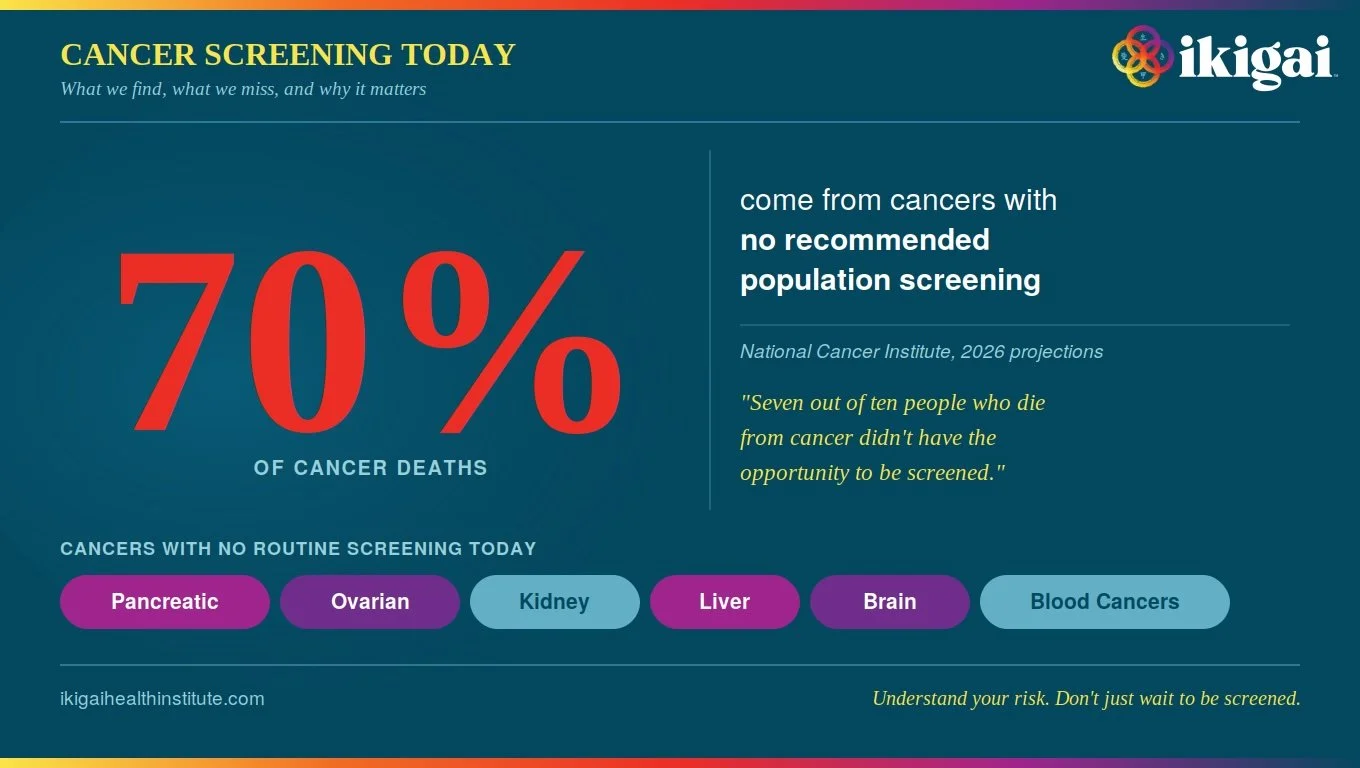
Cancer screening works remarkably well — for the cancers we know how to screen for. Mammograms, colonoscopies, cervical screening, and lung cancer CT scans have helped prevent millions of deaths. But roughly 70% of cancer deaths come from cancers with no recommended population screening strategy at all — including pancreatic, ovarian, kidney, liver, and brain cancers. This series is about what's proven, what's missing, and how individual risk can justify looking differently than population guidelines alone suggest.
What's in this post?
- Finding Cancer Earlier Can Change Everything
- Some Cancers Give Us a Better Opportunity Than Others
- Cancer Screening Works — But Only Where We Know How to Make It Work
- The Cancers We Don't Routinely Screen For
- Population Medicine and Individual Medicine Ask Different Questions
- Technology Is Moving Faster Than the Guidelines
- We Think There Is a Better Question
- Why We're Having This Conversation
Cancer screening has an unusual problem: when it works well, nothing particularly dramatic happens. A precancerous colon polyp is removed during a colonoscopy and never becomes colon cancer. A mammogram identifies a small breast cancer before it has spread. A low-dose CT finds lung cancer while it's still localized. Years later, that person is living their life, often without any sense that a very different future may have been avoided.
That quiet success has occurred millions of times. Modern cancer screening is one of medicine's great achievements. Along with prevention and better treatment, it has helped drive substantial reductions in deaths from cancer over the past several decades. For four cancers with guideline-recommended population screening — breast, cervical, colorectal, and lung — along with prostate cancer, where PSA screening is an individualized decision, National Cancer Institute modeling estimates that prevention and screening accounted for approximately 4.75 million deaths averted in the United States between 1975 and 2020. That is an extraordinary accomplishment, and any discussion about improving cancer screening should begin by acknowledging how much the existing approach gets right.
But there's another number worth knowing: roughly 70% of cancers diagnosed in the United States — and roughly 70% of cancer deaths — come from cancers for which there is no guideline-recommended population screening strategy. Despite extraordinary progress, cancer remains the second-leading cause of death in the United States, with approximately 2.1 million Americans expected to be diagnosed and more than 626,000 expected to die from cancer in 2026. We have remarkably effective screening for some cancers. For many others, a person without symptoms who is otherwise at average risk is not routinely screened at all.
That doesn't necessarily mean we have no test or technology capable of detecting those cancers. In some cases, blood tests or imaging can look for them. Rather, the evidence has not demonstrated enough benefit relative to potential harm to support routinely screening millions of people without symptoms who are otherwise at average risk. Guidelines generally do not recommend these approaches for routine screening, and insurance often does not cover them for that purpose. That distinction is important — and the gap between what we routinely screen for and the cancers that still cause most cancer deaths is where this conversation begins.
Finding Cancer Earlier Can Change Everything
Cancer is not one disease, and the odds of surviving it are not captured by one number. What happens next depends on the cancer, its biology, the person — and, critically, how far the disease has spread when we find it.
Breast cancer provides a striking example. When female breast cancer is found while still localized to the breast, five-year relative survival is more than 99%. Once it has spread to distant parts of the body, five-year relative survival is about 32%. "Relative survival" compares people with a particular cancer with people in the general population of the same age and sex, giving us a way to estimate the effect of the cancer itself. For ovarian cancer, the difference is similarly dramatic: current U.S. data show five-year relative survival of more than 90% when ovarian cancer is localized, compared with roughly 30% after distant spread. Unfortunately, only a minority of ovarian cancers are found while still localized. Pancreatic cancer is more sobering still. When pancreatic cancer is discovered while localized, five-year relative survival is approximately 44%. When it's discovered after distant spread, survival falls to roughly 3%.
These numbers should not be interpreted as predictions for any individual. Cancer treatment continues to improve, cancer biology differs from person to person, and five-year survival statistics necessarily look backward at people treated in previous years. But the broader message is difficult to miss: for many cancers, how far the disease has spread when it's discovered profoundly influences what happens next. That's why early detection is so compelling — and why our inability to reliably detect many cancers early remains such an important problem.
Some Cancers Give Us a Better Opportunity Than Others
Breast cancer is frequently found before it has spread. Approximately 64% of female breast cancers are diagnosed while localized. Now compare that with pancreatic cancer. Only about 15% is diagnosed while localized; approximately half is already metastatic when discovered. Ovarian cancer presents a similar challenge, with only a minority of cases discovered while the cancer remains localized and many diagnosed after the disease has already spread.
Why are some cancers so much easier to screen for than others? Some give us something to find before they become dangerous, such as a precancerous polyp in the colon or abnormal cells on cervical screening. Some develop in places we can image effectively. Some leave biological clues we can measure. And sometimes we can identify a group of people whose risk is high enough that looking makes sense. For screening to work, we need to be able to find a cancer early enough to matter, with a test accurate enough that the benefit of looking outweighs the harm caused by false alarms, in a group of people for whom screening makes sense. For some cancers, we simply do not yet have a screening strategy that clears that bar when applied broadly.
The result is a strange asymmetry in modern medicine. Once cancer is found, we can analyze the genetics of a tumor, choose treatments aimed at specific molecular targets, enlist the immune system to attack certain cancers, and deliver radiation with extraordinary precision. Yet for many cancers, our first clue that they exist is still a symptom. For all the sophistication that follows a cancer diagnosis, finding some cancers before they cause trouble remains remarkably difficult.
Cancer Screening Works — But Only Where We Know How to Make It Work
The purpose of screening is to look for disease in people who do not have symptoms. That distinction matters. Once a patient develops unexplained bleeding, a new mass, persistent pain, or another concerning symptom, we are no longer talking about screening. We are investigating a potential problem.
A good screening test therefore has an extraordinarily difficult job because we are applying it largely to healthy people, most of whom do not have the disease we are looking for. Simply finding more abnormalities is not enough. An effective screening program should find cancer early enough to change what happens next and, ultimately, reduce the risk of dying from it. At the same time, the benefits must outweigh the harms created by false-positive results, unnecessary biopsies and procedures, false reassurance, and overdiagnosis — finding cancers that would never have caused harm.
For several cancers, medicine has met that standard. Mammography reduces the risk of dying from breast cancer. Cervical screening can identify and allow treatment of precancerous changes before cervical cancer develops. Colorectal screening can find cancer earlier and, through colonoscopy and other strategies that identify precancerous polyps, sometimes prevent cancer from developing at all. Low-dose CT reduces the risk of dying from lung cancer in appropriately selected people with significant smoking histories. Prostate cancer is more complicated. PSA testing can be valuable, but whether and how to use it depends on the person — their age, risk factors, preferences, and what we would do with the result.
These programs deserve enormous credit, and the goal of a more proactive approach to cancer detection should never be to discard what has already been proven to work. The first priority is to do the proven things well. NCI modeling estimates that prevention and screening accounted for approximately 4.75 million of the cancer deaths averted between 1975 and 2020 across breast, cervical, colorectal, lung, and prostate cancers, demonstrating just how powerful these approaches can be where effective strategies exist. But the other side of that success is equally important: roughly 70% of cancer deaths still arise from cancers without a recommended population screening strategy. Pause on that statistic for a moment. Seven out of ten people who die from cancer didn't have the opportunity to be screened. Once we've done the proven things well, an obvious question remains: what about everything else?
The Cancers We Don't Routinely Screen For
Think about some familiar cancers: pancreatic, ovarian, kidney, liver, brain, and many blood cancers. There is no broadly recommended screening program for most average-risk adults for many of these diseases.
That doesn't mean physicians don't care about finding them early, nor does it necessarily mean there is no technology capable of looking for them. It means we have not demonstrated that routinely testing millions of people without symptoms with available tools produces more benefit than harm. Ovarian cancer illustrates the problem well — a topic we cover in more depth in our guide to the well-woman visit. It would seem intuitive that routinely measuring the blood marker CA-125 or performing pelvic ultrasound should help us find ovarian cancer earlier. Unfortunately, these approaches have not been shown to reduce the risk of dying from ovarian cancer when used to screen average-risk women, and abnormal results can trigger additional imaging and even surgery in women who do not have cancer.
There's an important lesson here that will recur throughout this series: a test's ability to find something does not automatically make it a good screening test. That's why population screening recommendations are appropriately conservative. Before recommending a test for tens of millions of healthy people, we should have strong evidence that it improves outcomes and that its benefits exceed its harms.
We agree with that standard. We also think it answers a somewhat different question from the one we're trying to answer for an individual patient.
Population Medicine and Individual Medicine Ask Different Questions
Public-health screening guidelines have an enormous responsibility. A test may sound promising, but recommending it to millions of healthy people requires much more than showing that it can find cancer. We need to know who is likely to benefit, how often the test raises a false alarm, what happens after an abnormal result, and whether finding the cancer earlier actually changes the outcome. We also have to account for the harms created along the way — from anxiety and additional imaging to biopsies, procedures, and treatment that may ultimately prove unnecessary.
The goal is not to find every possible cancer in every person as early as technology allows. The goal is to recommend screening when evidence demonstrates that the benefits outweigh the harms across the population being screened. That distinction is fundamental to understanding both the tremendous value of screening guidelines and their inherent limitations when we move from a population to a particular person.
At Ikigai, we care deeply about population evidence. It's the foundation on which rational screening should be built. But our responsibility is ultimately to the individual sitting in front of us, which allows us to ask another set of questions about personal risk. What do this person's age, family history, genetics, and past medical history tell us about risk? Are there important exposures or previous findings that change how we should think about screening? And are we actually completing the proven screening that applies to this person, at the right time and with the right follow-up?
Then comes the more difficult question: is there something about this individual that justifies starting earlier, looking more often, or using a different approach? And are there newer or less broadly recommended technologies that could reasonably add useful information beyond established screening? Those questions take us beyond simply checking whether someone is "up to date." They also make cancer screening much more interesting — and much more complicated.
Technology Is Moving Faster Than the Guidelines
We can now look for cancer in ways that were impossible a generation ago. Advanced imaging can examine large portions of the body without waiting for symptoms to direct us to a particular organ. Genetic testing can identify inherited predispositions that meaningfully change cancer risk. New blood tests can search for molecular signals associated with multiple cancers simultaneously. Improvements in imaging, artificial intelligence, and molecular diagnostics will almost certainly expand these capabilities further.
It's tempting to conclude that we should simply use all of them, but we don't think that's the answer. Every additional test creates the possibility of finding something important, while also creating the possibility of finding something unimportant that looks important. A tiny lung nodule, a renal cyst, a liver lesion, or an unusual signal on a blood test may require another scan, a specialist consultation, a biopsy, or months of surveillance before we know what it means.
More information can be valuable, but more information can also create harm. The future of cancer screening therefore cannot simply be about looking harder. It must be about learning how to look smarter.
We Think There Is a Better Question
Much of routine preventive care asks a straightforward question: are you up to date on your cancer screening? We think that question is necessary, but incomplete. A more useful conversation begins with understanding which cancers you are at meaningful risk for, what we can do to reduce that risk, which proven screening strategies apply to you, and whether there's anything about you that justifies looking differently.
Then, if we choose to look, we need a plan for what happens when we find something. Screening is not completed when a test is ordered. An abnormality that requires repeat imaging in twelve months has created a twelve-month obligation. A colon polyp may determine the timing of the next colonoscopy years later. A rising PSA may matter more as a trend than as an isolated number. A family member's new cancer diagnosis can alter a risk assessment that was perfectly reasonable five years earlier.
Cancer screening should therefore be thought of not as a collection of tests, but as a longitudinal system. Understand someone's risk first. Reduce the risks we can. Do the proven screening well. Selectively add other tools when they make sense. And, critically, never lose track of what we find. An abnormality that needs attention six months or three years from now still needs to be there waiting for us six months or three years from now. As the patient, the family history, and the science change, we reassess the strategy and begin the cycle again.
Why We're Having This Conversation
Over the next several months, we are going to take cancer screening apart and rebuild it from the patient's perspective. We will look at how personal and family history change risk, what conventional cancer screening gets right, and where its limitations lie. We will discuss genetics, multi-cancer early detection blood tests such as Galleri, whole-body MRI, and other advanced imaging. We will talk about the incidental findings these technologies inevitably uncover and what should happen after something abnormal appears. We will also examine something that can get lost amid all the excitement about early detection: how much cancer risk may be influenced before cancer ever develops.
We won't argue that every patient needs every test, that newer automatically means better, or that today's technology can guarantee cancer will be detected early. Our objective is more grounded than that. Cancer remains one of the greatest threats to healthspan and lifespan. Earlier detection can profoundly change the trajectory of some cancers, yet our ability to screen for cancer remains uneven. Population guidelines give us an essential foundation, but an individual patient's story may give us reasons to think beyond that foundation.
At Ikigai, that is the opportunity we're interested in exploring: not more screening for the sake of screening, but a more thoughtful strategy for improving the odds of finding the cancers that matter while we still have time to change what happens next.
Take the Next Step
Wondering whether your own screening plan is actually complete — or whether your personal risk justifies a different approach than the standard guidelines? That's exactly the conversation we have with every new patient.
Schedule a Consultation — Get a personalized cancer risk assessment, not just a checklist of what's "due."
Join the Ikigai Newsletter — Follow this series as we publish it over the coming months.
Explore Our Programs — See how Ikigai integrates cancer risk into a complete longevity strategy.
Recommended Reading
Breast Cancer: Why Early Detection Changes Everything — A closer look at the cancer screening does best.
The Well-Woman Visit: From Prevention to Personalized Longevity Care — Where ovarian and other women's cancers fit into a broader prevention strategy.
Identifying Your Personal Risk — The framework behind the individual risk questions raised in this post.
What Is Longevity Medicine — How cancer screening fits into the Ikigai approach to prevention.
The information in this post is for educational purposes only and is not intended as medical advice. Screening decisions should always be made with a physician who knows your personal and family history.



Stop guessing. Start optimizing.
You have a strategy for your wealth and your career. It's time to build one for your health.