
Brain Health Is Built, Not Found: A New Framework for Cognitive Longevity
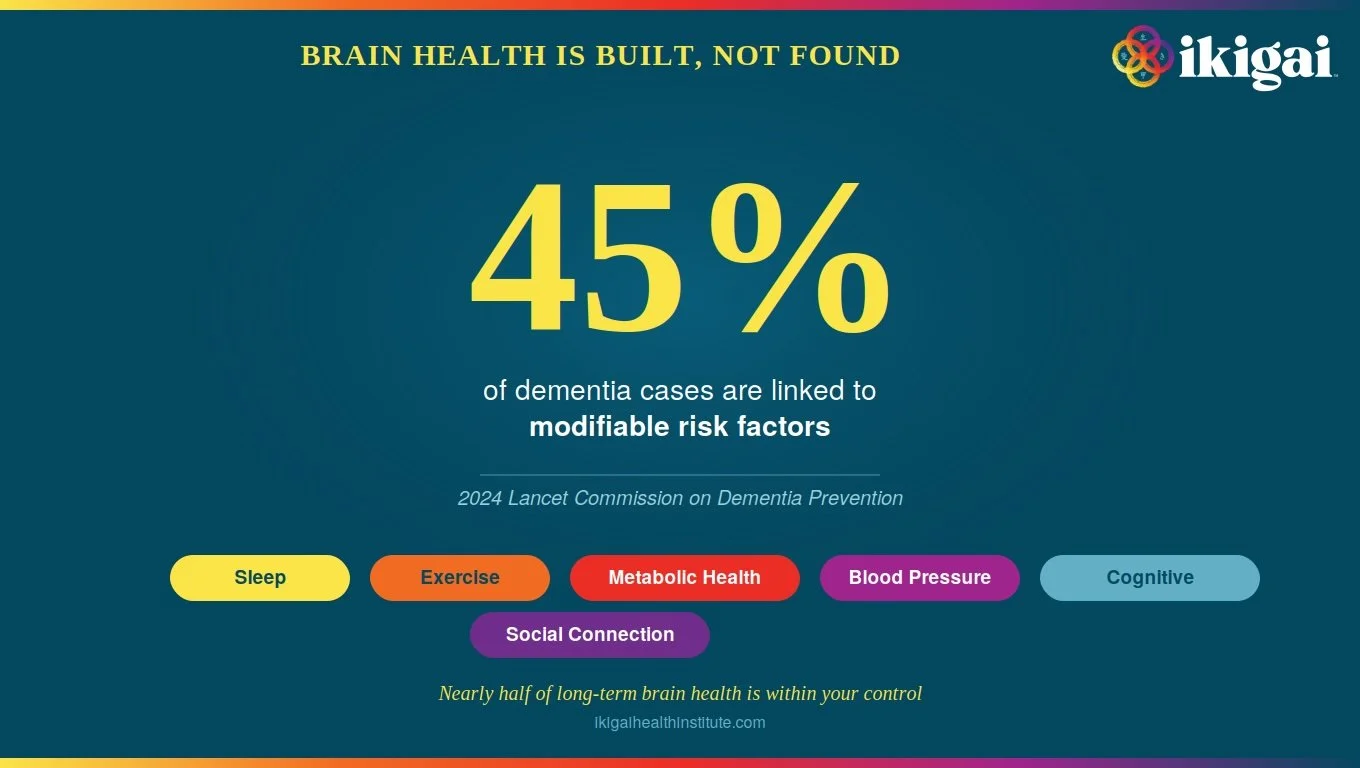
Can you prevent dementia and cognitive decline? Yes. Recent research indicates that up to 45% of dementia cases are linked to modifiable risk factors that can be managed decades before symptoms appear. Effective brain health management requires a "compounding stack" of interventions, including intensive blood pressure control, metabolic health optimization, treating hearing loss, and improving sleep quality. Because Alzheimer’s and other dementias develop silently over 10–20 years, early measurement of cognitive baselines is the most effective way to transition from damage control to true prevention.
What’s in this post?
How We Think About Brain Health at Ikigai
Most people think about brain health the wrong way.
They think about it when something goes wrong—memory slips, missed names, a growing sense that something isn’t quite as sharp as it used to be. By that point, the conversation has already shifted from prevention to damage control. For example, a patient may feel cognitively sharp in their 40s or 50s, yet have underlying insulin resistance, elevated blood pressure, or untreated hearing loss—factors that quietly increase long-term risk.
At Ikigai, we approach brain health differently. We treat it the same way we think about cardiovascular disease, cancer, and metabolic health: as a long game—one that starts decades before symptoms and can be shaped, measured, and improved over time. In fact, up to 45% of dementia cases are linked to modifiable risk factors, meaning nearly half of long-term brain health is within our control if we start early enough.
Brain Health Isn’t Just About Dementia
Is brain health only about preventing Alzheimer’s?
When patients hear “brain health,” they often think about Alzheimer’s disease, but that’s only part of the story. It’s also worth noting that Alzheimer’s disproportionately affects women—a topic we explore in our article: Why Alzheimer’s Disease Disproportionately Affects Women.
Brain health exists on a spectrum, from performance—focus, memory, processing speed, creativity—to decline, including mild cognitive impairment and dementia. Most of the drivers that influence one side influence the other, which means the same habits that help you think clearly today are the ones that reduce your risk decades from now.
The Long Runway of Brain Aging
When does cognitive decline actually begin?
One of the most important—and least understood—facts about brain health is that decline doesn’t start when symptoms appear.
Conditions like Alzheimer’s disease often develop silently over 10–20 years before a diagnosis is ever made. Normal cognitive function today does not equal low risk—in fact, the biological changes that drive cognitive decline are often already underway long before anything feels different. This is why we focus on early detection and risk tracking, not just symptom recognition.
No Single Lever Changes Everything
What are the modifiable risk factors for brain health?
Patients often look for the one thing—the supplement, the diet, the app—that will move the needle, but brain health doesn’t work that way.
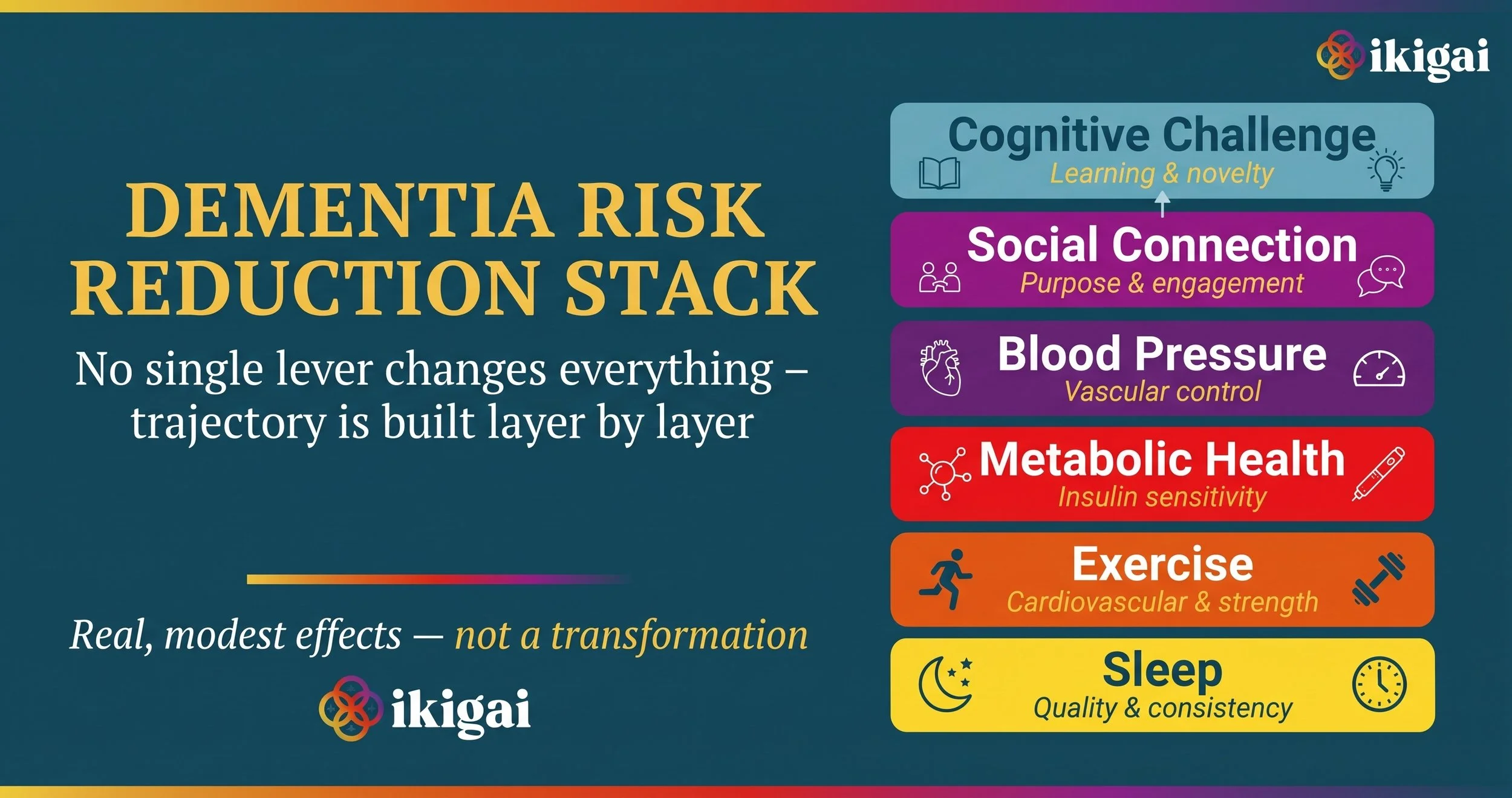
No single risk factor dominates, and no single intervention solves the problem. What matters is the accumulation of small advantages—and small risks—over time. We call this the stack: sleep, exercise, metabolic health, blood pressure, social connection, and cognitive challenge each contribute a piece. For example, untreated hearing loss is one of the largest modifiable risk factors for dementia, and intensive blood pressure control has been shown to reduce the risk of cognitive impairment. On their own, these factors matter; together, they define trajectory.
Risk vs. Performance: Two Sides of the Same System
At Ikigai, we separate brain health into two related but distinct domains: risk and performance.
Risk reflects what’s happening beneath the surface—the biology that increases or decreases your likelihood of future decline—while performance is what you can feel today: focus, memory, clarity, and processing speed. These don’t always move together. You can feel sharp and still carry significant long-term risk, or feel off due to sleep, stress, or overload without underlying disease. Understanding both is critical.
Measurement Before Symptoms
Why should I get cognitive baseline testing early?
In traditional medicine, the brain is often assessed late—we wait for complaints, then we test.
At Ikigai, we do the opposite. We establish baselines early using cognitive testing that evaluates memory and processing speed, along with key drivers of brain health like metabolic markers and vascular risk factors. This allows us to detect subtle changes earlier, personalize interventions, and track whether what you’re doing is actually working, because what gets measured gets managed.
Brain Health Is Built—Not Found
There’s no single test that tells you your brain is “good” or “bad,” and no moment where you’re suddenly safe or suddenly at risk. Brain health is built gradually through daily behaviors, long-term habits, and decisions that compound over years. Importantly, it’s modifiable—more than most people realize.
Let’s build your healthy brain together. Contact Us to learn how.
Recommended Reading
Why Alzheimer’s Disease Disproportionately Affects Women - Explore the unique biological, hormonal, and lifestyle factors—including the impact of the menopausal transition—that make Alzheimer’s prevention a critical priority specifically for women.
Biological Age vs. Chronological Age: How to Measure Your True Health - Learn how we go beyond the calendar to measure your rate of cellular aging, providing a high-resolution look at how your lifestyle choices are impacting your long-term brain and body health.
ApoB vs. LDL: How to Truly Measure Your Cardiovascular Risk - Because vascular health is the foundation of brain health, we break down why measuring particle count (ApoB) is a far more accurate predictor of stroke and cognitive decline than standard cholesterol panels.
HRV Trends: How to Use Your Data to Drive Decisions - Discover how tracking heart rate variability stability—rather than just a daily score—acts as a real-time "dashboard" for your nervous system's resilience and its ability to handle stress.
