
Can Hearing Aids Reduce Dementia Risk? What the ACHIEVE Trial Found
Can hearing aids reduce dementia risk? Emerging research suggests untreated hearing loss may accelerate cognitive decline and raise dementia risk over time. The ACHIEVE trial — one of the most important brain health intervention studies in recent years — found that treating hearing loss slowed cognitive decline by nearly 48% in higher-risk older adults. Hearing aids are not proven to prevent dementia outright, but the evidence linking hearing aids to slower cognitive decline is growing rapidly. Hearing health is increasingly viewed as one of the most actionable and underappreciated components of long-term brain health.
What's in this post?
Why hearing loss matters for the brain: More than a quality-of-life issue.
The ACHIEVE trial — what it actually found: Why the headlines missed the most important result.
How hearing loss affects brain biology: Cognitive load, social isolation, and brain atrophy.
Hearing loss and the Lancet Commission: The single largest modifiable dementia risk factor.
Screening vs. red flags: When to evaluate and what not to ignore.
Access and cost — what's changed: OTC hearing aids and the new landscape.
What you can do now: Practical next steps.
Why Hearing Loss Is a Dementia Risk Factor
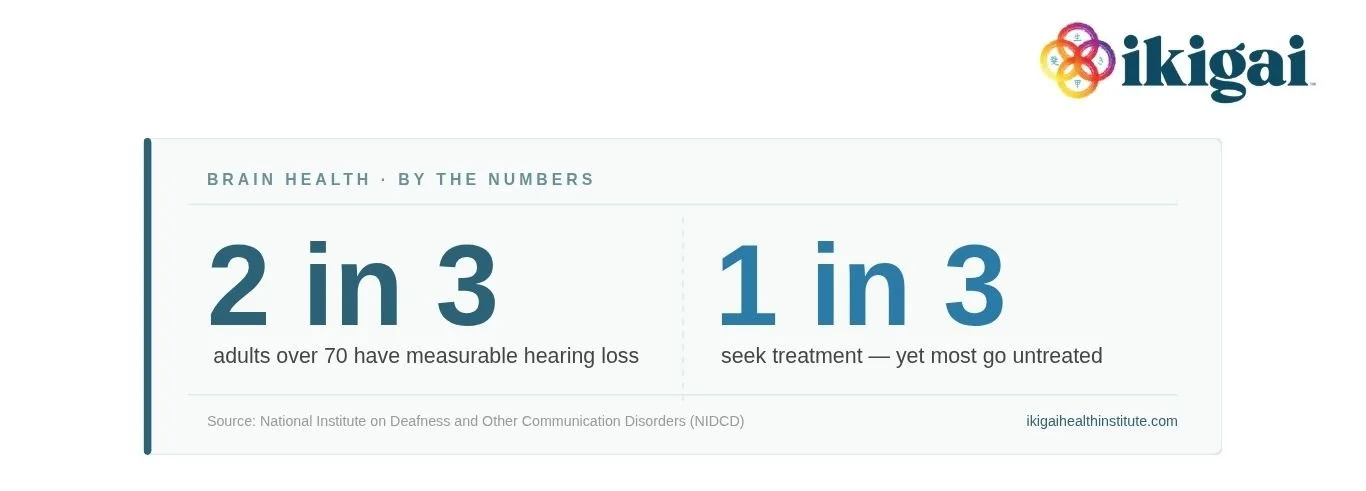
Two out of three adults over age 70 have measurable hearing loss. Fewer than one in three use hearing aids.
For years, hearing loss was viewed primarily as a quality-of-life issue — frustrating conversations, louder televisions, increasing difficulty in noisy environments. But a growing body of research suggests something much bigger may be happening beneath the surface: untreated hearing loss may accelerate cognitive decline and increase dementia risk.
Over the past decade, hearing loss has emerged as one of the strongest modifiable risk factors for dementia. Researchers are increasingly investigating whether treating it with hearing aids may help reduce that risk and support healthier brain aging.
That possibility moved from theory to serious clinical evidence with the publication of the ACHIEVE trial — one of the most important brain health studies in recent years.
The ACHIEVE Trial: What It Actually Found
The ACHIEVE trial (Aging and Cognitive Health Evaluation in Elders) was a large randomized controlled trial conducted across four academic medical centers in the United States. Nearly 1,000 adults between ages 70 and 84 with untreated hearing loss were enrolled and followed for three years.
Participants were randomly assigned to one of two groups. One received a comprehensive hearing intervention — hearing aids, audiologist counseling, communication coaching, and ongoing support. The control group received healthy aging education but no hearing treatment. Researchers tracked memory, processing speed, and overall cognitive performance over time.
This was not a small observational study. It was a carefully designed randomized trial aimed at answering one straightforward question: can treating hearing loss slow cognitive decline? The study was published in The Lancet.
Why the Headlines Missed the Most Important Finding
When the primary results were released, many headlines described the trial as "negative" — because the overall study population did not show a statistically significant slowing of cognitive decline.
But that interpretation overlooked something critical.
The trial actually included two very different populations. One group consisted of relatively healthy community volunteers. The other came from the long-running ARIC cardiovascular study — adults with substantially higher baseline risk, including greater cardiovascular disease burden and lower baseline cognitive scores.
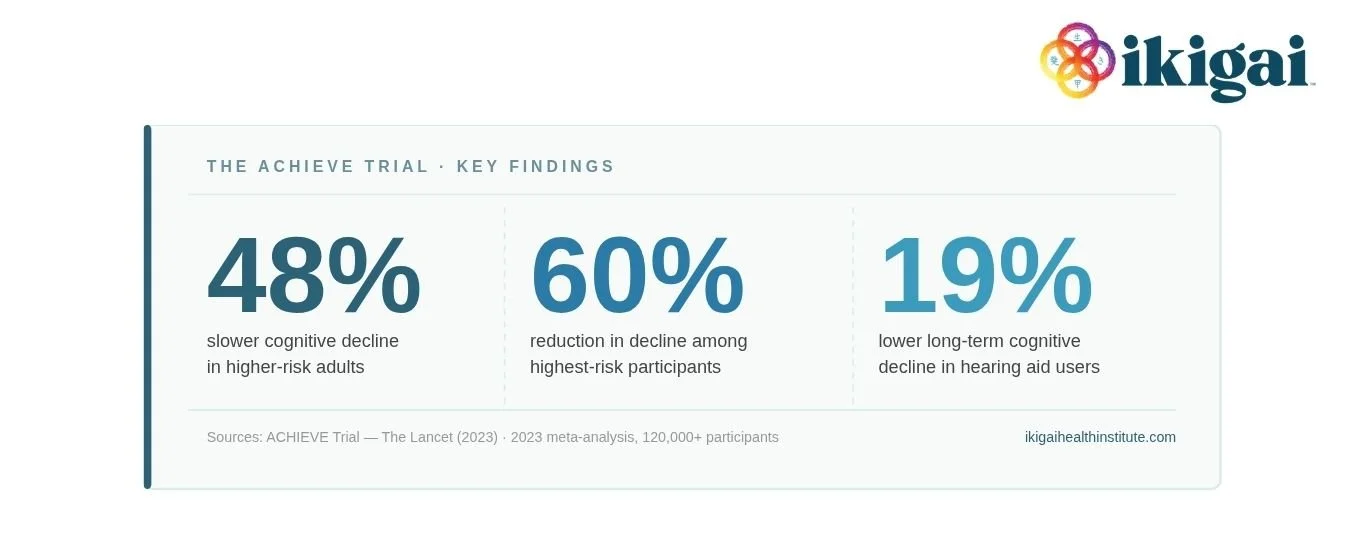
Among those higher-risk participants, the results changed dramatically. The hearing intervention slowed cognitive decline by 48% over three years. A later analysis found that participants in the highest predicted-risk category experienced roughly a 60% reduction in cognitive decline.
Those are remarkably large effects for a non-drug intervention.
The lower-risk group showed little measurable difference — but that may not be surprising. These participants started with stronger cognitive performance and declined much more slowly, leaving less room for a detectable difference over a relatively short study window. In prevention medicine, the absence of short-term measurable change is not the same as the absence of long-term preventive benefit. That distinction is central to how we think about risk at Ikigai.
That interpretation becomes even more compelling alongside the broader literature. A large 2023 meta-analysis involving more than 120,000 participants found hearing aid use was associated with a 19% lower hazard of long-term cognitive decline. Those studies are observational and cannot fully prove causation — but when viewed together, the evidence paints an increasingly compelling picture.
The ongoing 6-year extension of the ACHIEVE trial may provide more definitive answers.
How Does Hearing Loss Affect the Brain?
The relationship between hearing loss and cognition may sound surprising at first — but biologically, it makes sense. Researchers believe untreated hearing loss may stress the brain through several overlapping mechanisms.
Cognitive overload. When hearing becomes impaired, the brain works harder simply to interpret sound. Instead of effortlessly processing conversation, it reallocates resources toward decoding incomplete speech signals. Over time, that increased listening effort may divert mental resources away from memory, attention, and complex thinking — contributing to mental fatigue and reduced brain resilience.
Social withdrawal. Hearing loss changes behavior long before most people recognize it. Restaurants become exhausting. Group conversations become frustrating. Phone calls get harder. Gradually, many individuals begin withdrawing socially — and social isolation is itself a major risk factor for dementia and cognitive decline. A secondary analysis from the ACHIEVE trial found that participants receiving hearing treatment preserved larger social networks and reported less loneliness over time.
Brain atrophy. Neuroimaging studies show that hearing loss is associated with accelerated brain volume loss, including changes in regions involved in memory and language processing. Data from the Framingham Heart Study found associations between hearing loss, smaller brain volumes, and increased long-term dementia risk.
As we explored in our Brain Health Series, the brain rarely declines through a single pathway. Long-term cognitive health is shaped by cumulative exposures across multiple systems — vascular, metabolic, social, and sensory — often developing quietly for years before symptoms emerge. Hearing fits squarely into that picture.
The Lancet Commission: The Single Largest Modifiable Risk Factor
The influential Lancet Commission on Dementia Prevention, Intervention, and Care identified hearing loss as the single largest modifiable risk factor for dementia across the life course — ranking above hypertension, diabetes, smoking, and physical inactivity in its estimated contribution to population-level dementia risk.
Their estimates suggest hearing loss may account for roughly 8% of dementia cases worldwide.
That does not mean hearing loss directly causes dementia in every case. But it does suggest that identifying and treating hearing impairment may represent one of the most actionable brain health opportunities available today.
For context: we do not wait to treat high blood pressure until a stroke occurs. We do not wait to address insulin resistance until diabetes develops. The goal is to reduce cumulative risk before measurable disease appears. Hearing health deserves similar thinking.
Routine Screening vs. Red Flags You Should Not Ignore
At Ikigai Health Institute, we increasingly view hearing assessment as a routine part of preventive health and brain health maintenance — similar to dental care, vision screening, or regular cardiovascular evaluation. Hearing evaluation is incorporated into our broader Brain Health Program, which focuses on identifying modifiable risk factors for cognitive decline years before symptoms emerge.
One of the core challenges with hearing loss is that it develops gradually. Many people adapt slowly and do not recognize subtle decline until communication difficulties become much more noticeable. Tracking hearing over time — rather than waiting for symptoms to become significant — creates more opportunity for early intervention.
Routine hearing evaluation is particularly valuable for:
Adults over age 50
Individuals with a family history of hearing loss
People with regular loud-noise exposure (work, concerts, firearms, music)
Adults interested in proactive brain health and longevity strategies
Anyone who wants to establish a baseline and track hearing over time
Red flags that should prompt more immediate evaluation:
Frequently asking people to repeat themselves
Increasing television or phone volume beyond what others prefer
Difficulty following conversations in restaurants or group settings
Feeling mentally exhausted after social interactions
Avoiding phone calls or social situations because conversations feel harder
Family members commenting on changes in your hearing
Ringing in the ears (tinnitus)
Sudden hearing loss
Dizziness or balance problems
Hearing loss noticeably worse in one ear
While gradual age-related hearing decline is common, sudden changes, one-sided hearing loss, pain, or neurologic symptoms should always be evaluated more promptly.
Access and Cost: What's Changed
Despite how common hearing loss becomes with age, treatment rates remain remarkably low. Many adults wait years — sometimes a decade — before seeking help. Historically, one of the biggest barriers has been cost: traditional prescription hearing aids often run between $1,000 and $6,000 out of pocket, without routine Medicare coverage.
But access is changing rapidly. In 2022, the FDA approved a new category of over-the-counter (OTC) hearing aids for adults with mild to moderate hearing loss — available without a prescription, often at substantially lower cost.
For many people, that meaningfully lowers the barrier to taking the first step.
Not every patient is an appropriate OTC candidate. Individuals with severe hearing loss, sudden changes, dizziness, ear pain, or hearing loss significantly worse in one ear should still undergo formal medical evaluation. But for millions of adults with gradual age-related hearing decline, hearing care is more accessible than it has ever been.
What You Can Do Now
If you are over 50 — or if family members comment that the television is too loud, conversations feel harder in noisy environments, or you find yourself asking people to repeat themselves more often — it may be time to evaluate your hearing.
A few practical steps can make a meaningful difference:
Schedule a hearing evaluation if you notice any changes — or simply to establish a baseline
Don't normalize progressive hearing decline as inevitable aging
Consider hearing aids earlier rather than later if recommended
Protect your hearing from chronic loud noise exposure
Think of hearing health as a longevity strategy, not just a hearing fix
The brain depends on sensory input, communication, and social engagement to remain resilient over time. The ACHIEVE trial suggests that helping people hear better may help them stay cognitively healthier longer. As we've outlined throughout our Brain Health Series, protecting the brain rarely comes down to one intervention. More often, it comes from reducing risk across multiple systems — years before disease becomes visible.
Hearing is one of those systems. And it is one worth paying attention to.
Take the Next Step
Hearing health is one part of a comprehensive brain health strategy. At Ikigai, we assess modifiable risk factors for cognitive decline — including hearing, metabolic health, cardiovascular function, sleep, and more — as part of a personalized longevity care plan.
Schedule a Brain Health Consultation — Build a personalized strategy for long-term cognitive resilience.
Join the Ikigai Newsletter — Get the full Brain Health Series delivered to your inbox.
Explore Our Programs — See how Ikigai integrates comprehensive risk assessment into your care.
Recommended Reading
Dementia Risk Factors: What You Can Control — A guide to the 14 modifiable risk factors linked to nearly half of all dementia cases, including hearing loss.
Brain Health Is Built, Not Found — The foundational framework for understanding how cognitive resilience is built over decades.
Insulin Resistance and Brain Aging — How metabolic dysfunction creates a brain energy gap long before symptoms appear.
How To Track Brain Health Before It Slips — The three-domain framework Ikigai uses to measure brain health proactively.
Exercise and Brain Health — How movement protects cognitive function through BDNF, VO₂ max, and metabolic health.
Why Alzheimer's Disproportionately Affects Women — The hormonal and biological factors that make brain health a women's health issue.
