
Your Wealth Plan Has a Manager. Does Your Health?
What would it look like to manage your health the way you manage your wealth? Most people who've built real wealth have sat across from an advisor and answered hard questions: What's your risk exposure? What's your time horizon? What's your plan if something goes wrong? Almost nobody gets asked those same questions about their health — even though health is the asset that makes every other asset usable. At Ikigai, we believe health deserves the same discipline as a financial plan: real data, a clear strategy, and someone paying attention over time, not just once a year.
The Asset Nobody Manages
Most people who've built real wealth have, at some point, sat across from an advisor and answered hard questions: What's your risk tolerance? What's your time horizon? Where are you exposed? What's your plan if something goes wrong?
Almost nobody gets asked those same questions about their health.
That's strange, when you think about it. Health is the asset that makes every other asset usable. And yet most of us manage it the way an unsophisticated investor manages money: no real data, no strategy, no one checking in — just an annual physical that amounts to a 15-minute snapshot, and a vague hope that nothing's wrong.
The System Isn't Built to Catch What Matters Most
It's not that healthcare in this country is bad. It's that it's designed for a different job than the one most people think it's doing.
The current system is very good at reactive care — stabilizing you once something has already gone wrong. If you're having a heart attack, you want to be in a modern emergency room. But the same system is not designed to find the risk of a heart attack years before it happens, or to catch a cancer while it's still highly treatable, or to flag the slow, quiet decline that leads to cognitive impairment.
That gap shows up in the numbers. Half of first-time heart attacks now occur in people under 60. These aren't freak events. They're the predictable result of risk that went unmeasured and unmanaged for years.
This is exactly the gap longevity medicine is designed to fill — not by replacing traditional care, but by operating in the years and decades before disease appears, when there is still something meaningful to do about it.
The Parable of the River
There's an old story used in medicine and public health that applies just as well here.
Two rescuers are standing by a fast-moving river. A child comes down the current, unconscious. They pull him out and start resuscitation, but then another comes, and another. The rescuers are overwhelmed. One of them finally stands up and starts walking upstream. "Where are you going?" the other shouts. "I'm going to find out who's throwing people in the water," she says.
Most healthcare — and most of our own health habits — operate downstream. We wait to be pulled out. The alternative is going upstream: identifying risk before it becomes a crisis, while there's still something you can do about it.
That is the entire premise of what we do at Ikigai.
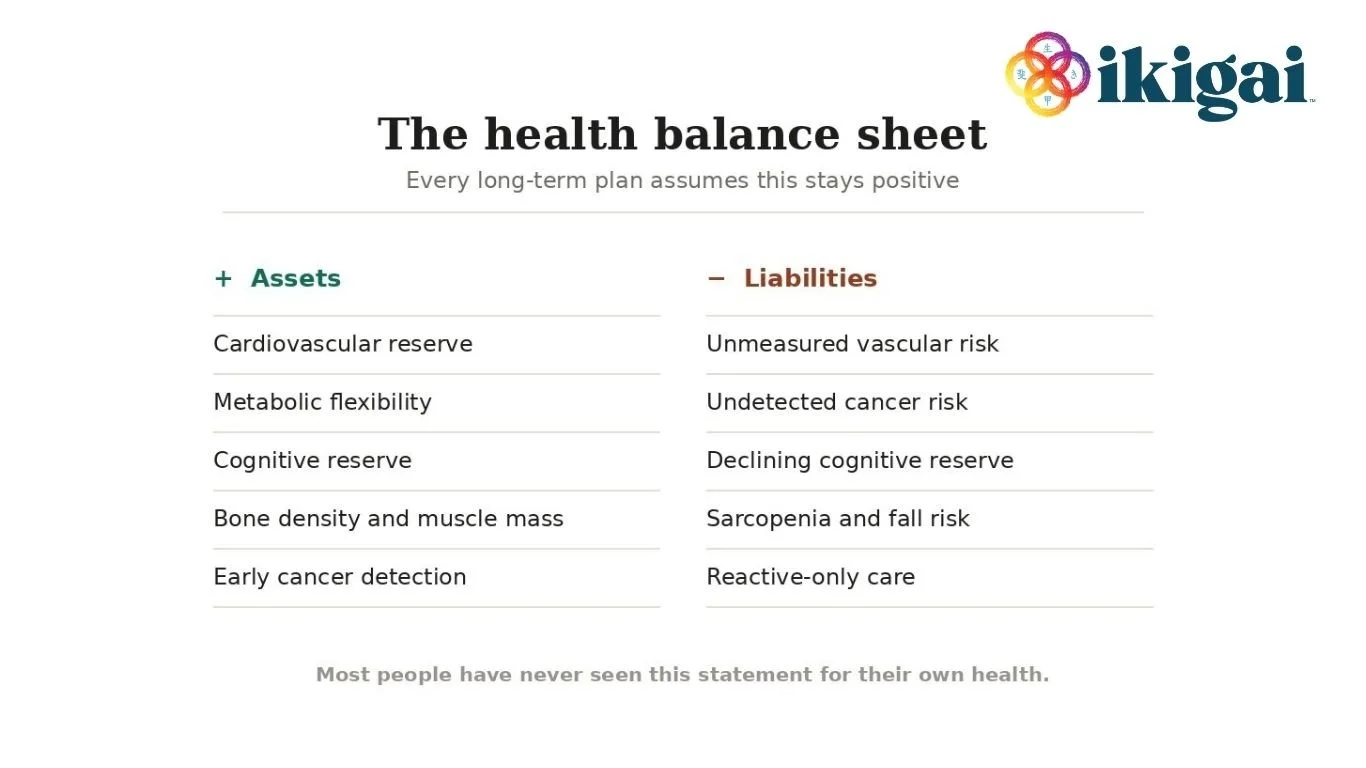
Thinking About Health Like a Balance Sheet
If you've ever worked with a good financial advisor, some of this vocabulary will sound familiar — because the underlying logic is the same.
Do you know your risk exposure? Not a guess — actual data on cardiovascular risk, metabolic function, cancer risk, and cognitive health. Are you building or burning? Every year, you're either accumulating physical reserve — strength, bone density, cardiovascular capacity, cognitive resilience — or quietly drawing it down. Most people don't know which direction they're heading because no one is measuring it. And what's your contingency plan? A financial plan accounts for downturns. A health plan should account for the equivalent — an injury, a diagnosis, an unexpected event — and whether you have the reserve to absorb it.
Here's a small but telling example: bone density and muscle strength don't feel urgent at 45 or 55. But a 60-year-old who breaks a hip in a fall has close to a 40% chance of dying within two years. That's not a random outcome — it's the result of years of an invisible balance sheet, unmanaged.
This is why at Ikigai we assess VO₂ max, grip strength, body composition, and physical capacity alongside cardiovascular and metabolic markers. Not because those numbers are interesting in isolation, but because they reveal whether someone is building reserve or drawing it down — and whether the trajectory is likely to support the life they want to live at 70, 80, and beyond.
As we explored in our post on normal vs. optimal lab ranges, a result that falls within a standard reference range is not the same as a result associated with the best long-term outcomes. Knowing the difference is the beginning of a real health strategy.
What a Health Plan Actually Looks Like
Most people have never had a physician sit down with them and ask: what do you actually want your life to look like at 80? What are you most afraid of losing? What risks are you carrying right now that you don't know about?
Those questions drive everything that follows at Ikigai.
A real health plan — like a real financial plan — starts with an honest assessment of where you are. That means advanced cardiovascular imaging, precision lipid panels including ApoB and Lp(a), metabolic testing including glucose tolerance and body composition, cognitive risk evaluation, physical capacity testing, and a careful review of the lifestyle factors that influence everything else.
From there, it involves a strategy — not a checklist, but a prioritized plan built around your actual risk profile and goals. And it requires continuity: someone who knows your history, monitors your trends, adjusts the plan as circumstances change, and is genuinely invested in the outcome. The opposite of a 15-minute annual physical.
If you're interested in what that looks like in practice, our Executive Vitality Program was designed specifically for this — a comprehensive, two-month assessment that treats health the way a serious investor treats a portfolio: with rigor, data, and a clear long-term strategy.
The Takeaway
You wouldn't let years go by without knowing your net worth, your risk exposure, or whether your plan was still on track. Health deserves the same discipline — real data, a clear strategy, and someone paying attention over time, not just once a year.
If you have a financial plan you trust, it's worth asking the parallel question: do you have a health plan you'd trust just as much?
If that question raises something worth exploring — or if you're simply curious what a genuinely proactive approach to your own health data would look like — it's a conversation worth having.
Take the Next Step
Schedule a Consultation — Start with a conversation about your goals and what a personalized health strategy would look like for you.
Explore Executive Vitality — A comprehensive two-month health audit designed for high performers who want to know exactly where they stand.
Join the Ikigai Newsletter — The clinical science behind longevity medicine, delivered weekly.
Recommended Reading
What Is Longevity Medicine? — What a proactive, physician-led approach to health actually involves — and how it differs from traditional care.
Normal vs. Optimal Lab Ranges — Why a normal result isn't always the same as an optimal one — and what the difference means for long-term risk.
VO₂ Max: Your Ultimate Longevity Predictor — Why cardiorespiratory fitness is one of the strongest predictors of long-term survival and independence.
What Drives Atherosclerosis? — How the most common cause of preventable death develops silently over decades.
Insulin Resistance and Long-Term Risk — Why metabolic health is one of the highest-leverage places to invest in your future.
Brain Health Is Built, Not Found — Cognitive resilience follows the same logic as physical reserve — it compounds over time, or quietly erodes.
The information in this post is for educational purposes only and is not intended as medical advice. Always consult with a physician before beginning any new health protocol.
