
Supplements for Brain Health: Promise, Hype, and Evidence
Do supplements help brain health? Some do — in the right person, for the right reason. At Ikigai, we are not anti-supplement. We recommend them to many of our patients. But we believe the more useful question is not "which supplement should I take?" — it's "what might my brain be missing?" Correcting a genuine deficiency in omega-3s, B vitamins, or vitamin D can meaningfully support brain health. Taking more of something you don't need rarely does. Used thoughtfully, supplements can complement a strong foundation. They cannot replace one.
What's in this post?
What we're really trying to protect: Brain healthspan, not just memory.
A better question to ask: Shift from "which supplement" to "what does my brain need."
Omega-3 fatty acids: One of the stronger cases.
B vitamins and homocysteine: The goal isn't the vitamin.
Vitamin D: Correct deficiency — don't chase miracles.
Creatine: More than a muscle supplement.
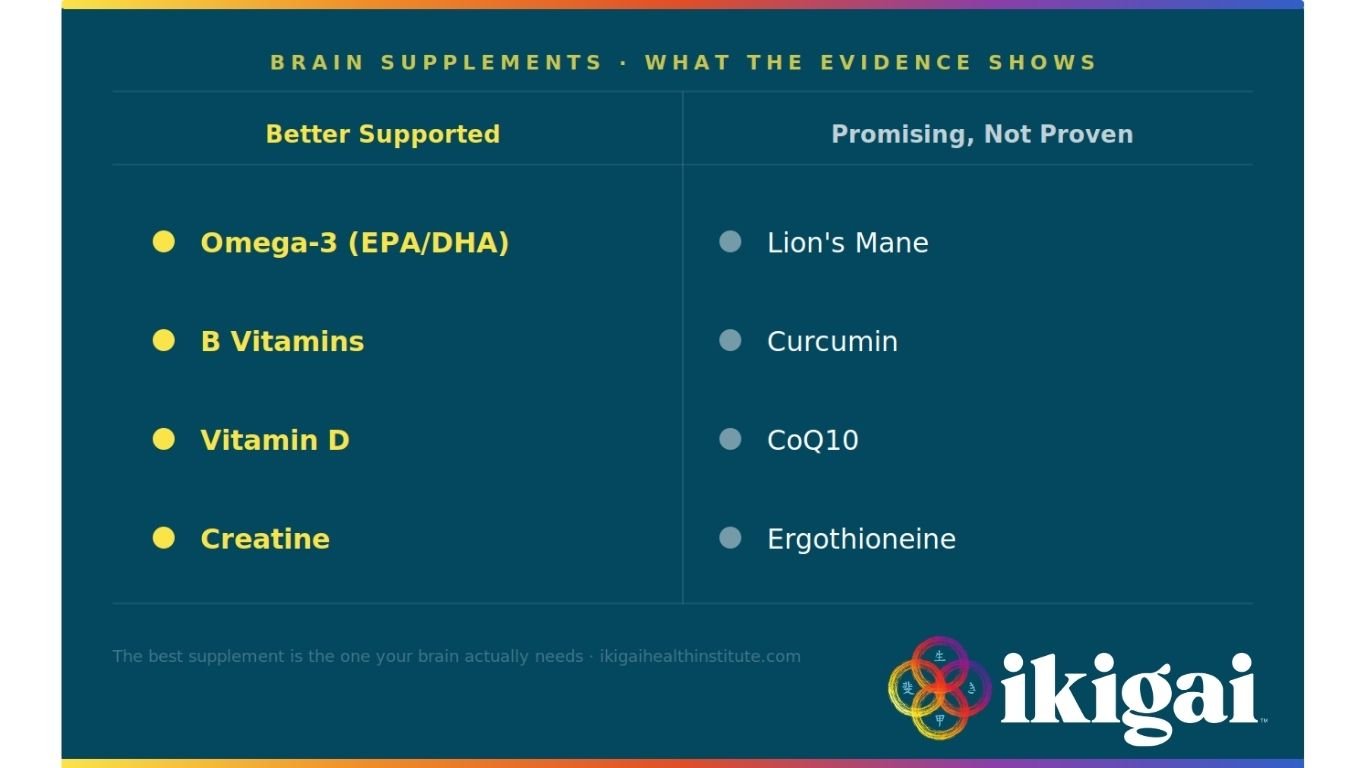
Lion's Mane, curcumin, and others: Interesting science isn't always proven science.
Don't let supplements become the main character: What matters far more.
Quality matters: How to choose wisely.
Supplements, Brain Health, and the Problem With Headlines
Every week seems to bring another product promising to sharpen your memory, improve your focus, or protect your brain from aging. One supplement claims to "reverse brain aging." Another advertises a proprietary mushroom blend as the missing key to cognitive performance. Social media is filled with physicians, scientists, influencers, and celebrities — often making very different claims about the same products. For patients trying to make informed decisions, it's easy to feel overwhelmed.
We hear these questions almost every day in clinic. Should I take fish oil? Does Lion's Mane really work? I've heard creatine is good for the brain — is that true? Is there a vitamin that prevents Alzheimer's disease? They are all reasonable questions, but they often begin from the wrong place.
At Ikigai, we are not anti-supplement. In fact, we recommend supplements to many of our patients. We simply believe they belong in the proper context. Some have biologic plausibility, favorable safety profiles, and enough evidence to justify thoughtful use in the right individual. Others are supported primarily by laboratory research or small preliminary studies. Still others are marketed with promises that extend far beyond what today's science can support. The challenge isn't deciding whether supplements are "good" or "bad." The challenge is learning to separate promise from hype and evidence from marketing.
What Are We Really Trying to Protect?
Before discussing individual supplements, it's worth stepping back and asking a more important question: what are we actually trying to accomplish?
Our goal isn't simply to improve memory or prevent Alzheimer's disease. At Ikigai, we think in terms of brain healthspan — the ability to think clearly, solve problems, learn new skills, remember the people and experiences that matter most, and remain independent throughout life. Protecting the brain means preserving the ability to stay engaged with family, meaningful work, hobbies, and the activities that give life purpose.
That goal depends on far more than finding the "right" supplement. Although the brain accounts for only about 2% of body weight, it consumes roughly 20% of the body's energy at rest. Problems that impair blood flow, energy production, sleep, or nutrition may seem small in isolation, but over decades they can influence how well the brain functions. Restorative sleep helps the brain clear metabolic waste products that accumulate during wakefulness — one of many reasons sleep has become such an important focus of brain health research.
Supplements may help support some of these systems, but they cannot replace them.
A Better Question
Patients often ask: "What's the best supplement for my brain?"
We think there's a better question: What might my brain be missing?
That subtle shift changes the conversation entirely.
If someone has a vitamin B12 deficiency, elevated homocysteine, inadequate omega-3 intake, or low vitamin D levels, correcting those problems may meaningfully support the biology of healthy brain aging. If those deficiencies do not exist, taking additional supplements may provide little or no benefit.
Rather than asking which supplement everyone should take, we ask what physiology needs support in a particular individual. We look for nutritional deficiencies, metabolic dysfunction, vascular risk factors, and lifestyle habits that may be limiting health. Supplements become one tool among many — not the starting point and rarely the entire solution.
Medicine is full of examples where replacing something the body genuinely lacks leads to meaningful improvement. The opposite is also true. Providing more of something that is already sufficient often yields diminishing returns. The brain is no exception.
With that framework in mind, the goal isn't to identify the "best" supplement. It is to understand which have the strongest evidence, which remain promising but unproven, and when correcting a true deficiency is likely to matter more than adding another capsule.
Omega-3 Fatty Acids: One of the Stronger Cases
Among the supplements commonly discussed for brain health, omega-3 fatty acids probably have one of the strongest overall evidence bases. Researchers became interested because DHA is a major structural component of neuronal membranes, while EPA and DHA also influence vascular health and inflammatory signaling. Since cardiovascular health and brain health are closely connected, it made sense to ask whether improving omega-3 status might also help preserve cognitive function.
The answer is nuanced. Studies looking specifically at dementia prevention have produced mixed results, and omega-3 supplementation should not be viewed as a guarantee against cognitive decline. At the same time, omega-3s remain among the better-supported supplements in longevity medicine because they contribute to cardiovascular health, lower triglycerides, and support normal neuronal function. Rather than viewing them as a "brain supplement," we think of them as one component of a broader strategy to support healthy aging — a position consistent with the findings from the DO-HEALTH trial, which we explored in our post on omega-3s and biological aging.
Patients who eat little seafood or who have a low omega-3 index may have the greatest opportunity to benefit. As with many interventions in longevity medicine, correcting an identifiable gap makes far more sense than assuming everyone requires the same supplement regimen.
B Vitamins: The Goal Isn't the Vitamin
B vitamins provide another example of why understanding the underlying biology matters more than the supplement itself.
When patients hear about vitamin B12 or folate, they often assume the goal is simply to increase vitamin levels. In reality, we are frequently trying to improve one-carbon metabolism — particularly by lowering elevated homocysteine. Elevated homocysteine has been associated with vascular disease, white matter changes, and increased rates of brain atrophy, making it an important area of interest in cognitive aging.
One of the most influential studies in this field, the VITACOG trial, found that participants with mild cognitive impairment and elevated homocysteine who received high-dose B vitamins experienced approximately 30% slower brain atrophy than those receiving placebo. Importantly, the greatest benefit occurred in individuals with higher homocysteine levels — not in everyone. That reinforces an important principle: correcting a biologic problem is often very different from supplementing someone who is already sufficient.
Our goal is not to recommend more vitamins. It is to identify patients in whom correcting a nutritional deficiency or improving homocysteine metabolism may reasonably support long-term brain health. The VITACOG trial also reminds us why baseline testing matters — a benefit seen in one population may not generalize to everyone.
Vitamin D: Correct Deficiency, Don't Chase Miracles
Vitamin D may be one of the most misunderstood supplements in medicine. Observational studies consistently found that people with lower vitamin D levels were more likely to experience cognitive decline and dementia — generating understandable excitement that supplementation might prevent these conditions.
The challenge is that observational studies cannot prove cause and effect. People with lower vitamin D levels may also exercise less, spend less time outdoors, or have other health conditions that independently increase their risk.
Randomized clinical trials have painted a more modest picture. The VITAL-Cognition substudy — one of the largest trials evaluating vitamin D and cognition — did not demonstrate meaningful cognitive benefit in generally healthy older adults. That does not diminish the importance of correcting deficiency; it simply reminds us that restoring normal physiology and preventing Alzheimer's disease are not necessarily the same intervention.
This is consistent with what we noted in our post on cardiovascular supplements: vitamin D deficiency should be corrected for overall resilience, but we avoid promising cognitive outcomes that the current evidence cannot yet support.
Creatine: More Than a Muscle Supplement
Ask most people about creatine and they'll think of gyms, weightlifting, and athletic performance. That's understandable — creatine has one of the strongest evidence bases of any supplement for improving muscle strength, preserving lean mass, and enhancing high-intensity exercise performance. What many people don't realize is that the brain is also an energy-intensive organ, creating a compelling biologic rationale for why creatine has attracted attention well beyond the fitness world.
Creatine helps regenerate ATP — the molecule that provides energy for nearly every cellular process in the body. Because neurons require enormous amounts of energy, researchers have become increasingly interested in whether improving the brain's energy reserve might help preserve cognitive function during aging, sleep deprivation, or other forms of physiologic stress. Several studies suggest creatine may improve cognitive resilience in older adults or under conditions of fatigue, but the evidence remains considerably less mature than the musculoskeletal literature.
That uncertainty doesn't diminish our interest in creatine. It is relatively inexpensive, has a favorable safety profile in healthy individuals, and offers well-established benefits for preserving strength and lean muscle mass as we age. Because physical capacity and brain health are closely intertwined, its greatest contribution to cognitive health may ultimately be indirect — helping people remain active enough to support the many other biologic processes that protect the brain.
Interesting Science Isn't Always Proven Science
Patients also ask us about Lion's Mane, curcumin, ergothioneine, and CoQ10. Each has generated considerable enthusiasm — and each illustrates an important lesson about interpreting scientific evidence.
Lion's Mane has demonstrated effects on nerve growth pathways in laboratory studies and shown encouraging results in several small human trials involving mild cognitive impairment. Curcumin has attracted interest because of its effects on inflammatory signaling. CoQ10 supports mitochondrial energy production and has established roles in selected cardiovascular conditions. Ergothioneine may be the least familiar of these compounds, yet it is one of the more scientifically intriguing because humans have evolved a dedicated transporter whose apparent purpose is to move ergothioneine into cells.
The common thread is that each of these compounds has biologic plausibility and has generated legitimate scientific interest. What they do not yet have is convincing evidence that they prevent Alzheimer's disease or meaningfully slow long-term cognitive decline in otherwise healthy adults. Most studies remain relatively small, use different formulations, or evaluate short-term cognitive outcomes rather than decades of brain aging.
As clinicians, we should be comfortable saying "this is promising, but we don't know yet." That isn't a weakness of science. It is one of its greatest strengths.
Don't Let Supplements Become the Main Character
One of the most common mistakes we see is investing enormous energy into supplements while neglecting the habits that matter far more. Someone may spend hundreds of dollars each month on capsules while sleeping five hours a night, exercising inconsistently, eating a highly processed diet, or struggling with uncontrolled blood pressure and insulin resistance. No supplement can compensate for that foundation.
If we had to choose between an excellent night's sleep and the perfect supplement stack, we would choose sleep every single time. The same is true for regular exercise, maintaining a healthy body composition, controlling blood pressure, optimizing metabolic health, and eating a nutrient-rich diet. Collectively, these interventions have substantially stronger evidence for preserving cognitive function than any supplement currently available.
This has been a recurring theme throughout our Brain Health Series. Nutrition, sleep, physical activity, hearing, stress management, social connection, and lifelong learning all influence one another over decades. None works in isolation, and no supplement can replace that foundation. Supplements are intended to complement healthy physiology — not compensate for unhealthy habits.
Quality Matters
When supplements are appropriate, quality matters. Unlike prescription medications, dietary supplements undergo a different regulatory process, and manufacturing quality varies considerably. Whenever possible, we recommend choosing products that undergo independent third-party testing through organizations such as USP, NSF, or IFOS for fish oil. These programs help verify that a product contains what the label claims and is free of common contaminants.
We also encourage patients to resist the temptation to build increasingly complicated supplement regimens. More supplements do not necessarily produce better outcomes. They increase cost, complexity, pill burden, and the potential for interactions while often providing little additional benefit. Our goal has never been to recommend the greatest number of supplements. It is to recommend the fewest interventions likely to provide meaningful benefit.
Building a Brain That Lasts
There is no perfect brain supplement, and we should be skeptical of anyone who claims otherwise. That doesn't mean supplements have no role in protecting cognitive health. Used thoughtfully, they can help correct nutritional deficiencies, support normal physiology, and provide incremental benefit with relatively little downside. The key is understanding what they can — and cannot — do.
At Ikigai, we don't begin by asking which supplement everyone should take. We begin by understanding the individual. We evaluate sleep, nutrition, metabolic health, cardiovascular health, physical activity, medications, laboratory data, and targeted nutritional deficiencies. Only then do we decide whether supplementation is likely to add meaningful value.
After months of exploring the science of brain aging in this series, one message has become increasingly clear: healthy brains are rarely built by a single intervention. They are built by the accumulation of small, consistent advantages over decades. That philosophy may never generate headlines promising to "reverse brain aging," but it reflects how longevity medicine is practiced.
For many people, the next meaningful step toward better brain health will not come from adding another capsule to the medicine cabinet. It will come from sleeping better, exercising consistently, eating a healthier diet, maintaining healthy blood pressure and metabolic function, remaining intellectually curious, and investing in meaningful relationships. When supplements are chosen thoughtfully and used for the right reasons, they can become valuable members of that team — but they should never be asked to carry it alone.
Take the Next Step
At Ikigai, we don't start with supplements. We start with understanding your individual physiology — where your labs stand, where your lifestyle stands, and where the greatest opportunities lie. Only then do we decide whether targeted supplementation is likely to add meaningful value.
Schedule a Consultation — Build a personalized brain health strategy grounded in your individual biology.
Join the Ikigai Newsletter — Get our Brain Health Series and longevity insights delivered to your inbox.
Explore Our Programs — See how Ikigai integrates advanced diagnostics, metabolic health, and lifestyle optimization into a personalized care plan.
Recommended Reading
Brain Health Is Built, Not Found — The foundational framework for long-term cognitive resilience — and why supplements belong near the bottom of the list.
Nutrition and Brain Health — Why whole foods provide what supplements cannot replicate.
Sleep and Brain Health — The intervention with the strongest evidence for brain maintenance — and it costs nothing.
Exercise and Brain Health — Why physical activity remains the most powerful supplement-free intervention for cognitive resilience.
Omega-3s and Biological Aging — What the DO-HEALTH trial found about omega-3s and cellular aging.
Cardiovascular Supplements: A Precision Approach — How the same precision framework applies to heart health supplements.
Normal vs. Optimal Lab Ranges — Why identifying true deficiencies requires looking beyond standard reference ranges.
Dementia Risk Factors: What You Can Control — The 14 modifiable factors with the strongest evidence — none of which is a supplement.
The information in this post is for educational purposes only and is not intended as medical advice. Always consult with a physician before beginning any new health protocol.
