
Technology, Attention, and Brain Health: What the Science Really Says
Does technology harm brain health? The headlines often say yes — but the science is more nuanced. There is little evidence that technology itself is causing dementia or meaningfully accelerating cognitive decline. In many ways, technology has made our lives healthier, safer, and more connected. What the research does suggest is that how we use technology matters — particularly its effect on attention. Because attention is the gateway to memory, learning, and deep thinking, protecting it may be one of the more underappreciated aspects of long-term brain health. The goal is not to fear technology. It's to use it with intention.
What's in this post?
Why attention matters more than memory: The cognitive resource we're not paying enough attention to.
The modern attention economy: What the research actually shows about interruptions and focus.
Technology is also helping our brains: The other side of the story.
Making technology work for your brain: How to use it in ways that support cognitive health.
Attention is a choice: The bottom line.
Phones, Screens, and the Brain
Take a moment to think about the last time you stood in line at the grocery store, waited for a flight, or sat in a doctor's office. Chances are that nearly everyone around you — including you — looked down at a screen within a matter of seconds. Our phones have become maps, calendars, cameras, libraries, newspapers, and constant companions. They help us navigate unfamiliar cities, reconnect with old friends, monitor our exercise, and answer almost any question imaginable. Few technologies in human history have changed daily life as quickly or as completely as the smartphone.
Not surprisingly, this transformation has been accompanied by growing concern about what constant connectivity might be doing to our brains. Headlines regularly warn that smartphones are "rewiring" our minds, social media is destroying attention spans, and digital technology is making us less intelligent. Those claims are compelling — but they often move well beyond what the evidence actually shows.
The research paints a more balanced picture. Technology itself is neither inherently good nor bad for brain health. In many ways, it has made our lives healthier, safer, and more connected. At the same time, there is growing evidence that the way we interact with technology can influence one of the brain's most valuable resources: attention. And because attention sits at the foundation of learning, memory, decision-making, and problem solving, understanding how we protect it may be more important than ever.
Why Attention Matters More Than Memory
For many people, brain health means memory. We worry about forgetting names, misplacing our keys, or struggling to recall why we walked into a room. Those experiences naturally lead us to ask whether our memory is changing. But memory depends on something that receives far less attention — our ability to pay attention in the first place.
Attention is the gateway to virtually everything else the brain does well. Before we can remember something, we have to notice it. Before we can solve a problem, learn a new skill, or have a meaningful conversation, we must first direct our attention toward it. In many ways, attention acts as the brain's filter — helping us identify what deserves our mental resources while allowing less important information to fade into the background.
Every day, we decide — consciously or not — where our attention goes. Those decisions quietly shape what we learn, what we remember, the relationships we build, and ultimately the lives we lead. Technology did not create this reality, but it has dramatically increased the number of things competing for our attention. Emails, text messages, news alerts, podcasts, streaming services, and social media feeds all ask for a small piece of the same finite resource. While each interruption may seem insignificant on its own, together they can create a world in which sustained attention has become increasingly difficult.
Imagine trying to fill a bucket with water while someone keeps poking holes in the bottom. No matter how much water you pour in, much of it escapes before the bucket fills. Attention works in much the same way. Every interruption — whether a notification, an incoming email, or the impulse to quickly check a text message — briefly redirects the brain's resources. Most of these interruptions seem trivial in isolation, but over the course of a day they can leave us feeling mentally scattered, even if we have been busy from morning until night.
The Modern Attention Economy
It is tempting to blame smartphones for every lapse in concentration or every forgotten name. The evidence simply doesn't support such sweeping conclusions. Scientists continue to study how digital technology influences cognition, and many important questions remain unanswered. What the research does suggest, however, is that our increasingly interrupted world may make it more difficult to sustain the kind of focused attention that learning, memory, creativity, and deep thinking require.
Many people describe themselves as good multitaskers, but neuroscientists have long understood that the brain performs surprisingly poorly when attempting multiple cognitively demanding tasks at once. Rather than doing several things simultaneously, it rapidly switches attention between them. Each switch requires the brain to reorient itself, and those transitions carry measurable cognitive costs. Research consistently demonstrates that frequent interruptions reduce productivity, increase errors, and make it more difficult to perform complex mental work.
One particularly interesting finding illustrates just how sensitive our attention can be. In a controlled laboratory study published in Frontiers in Computer Science in 2023, participants performed significantly worse on tests of concentration and attention when their smartphones were simply sitting on the desk beside them — even though the phones remained silent and were never used. The researchers concluded that the mere presence of a smartphone was enough to divert a small amount of cognitive resources away from the task at hand. For many of us, simply moving the phone out of sight may be one of the easiest ways to protect focused attention.
Technology is not solely responsible for these interruptions, but it has certainly increased their frequency. Notifications, incoming emails, text messages, and constantly updating feeds are all designed to capture our attention. That is not necessarily a criticism — for many digital platforms, engagement is simply the business model. It does, however, remind us that attention has become one of the most valuable commodities in the modern economy.
Technology Is Also Helping Our Brains
If this were the entire story, the solution would be simple: spend less time with technology. Fortunately, the science tells a much more encouraging story.
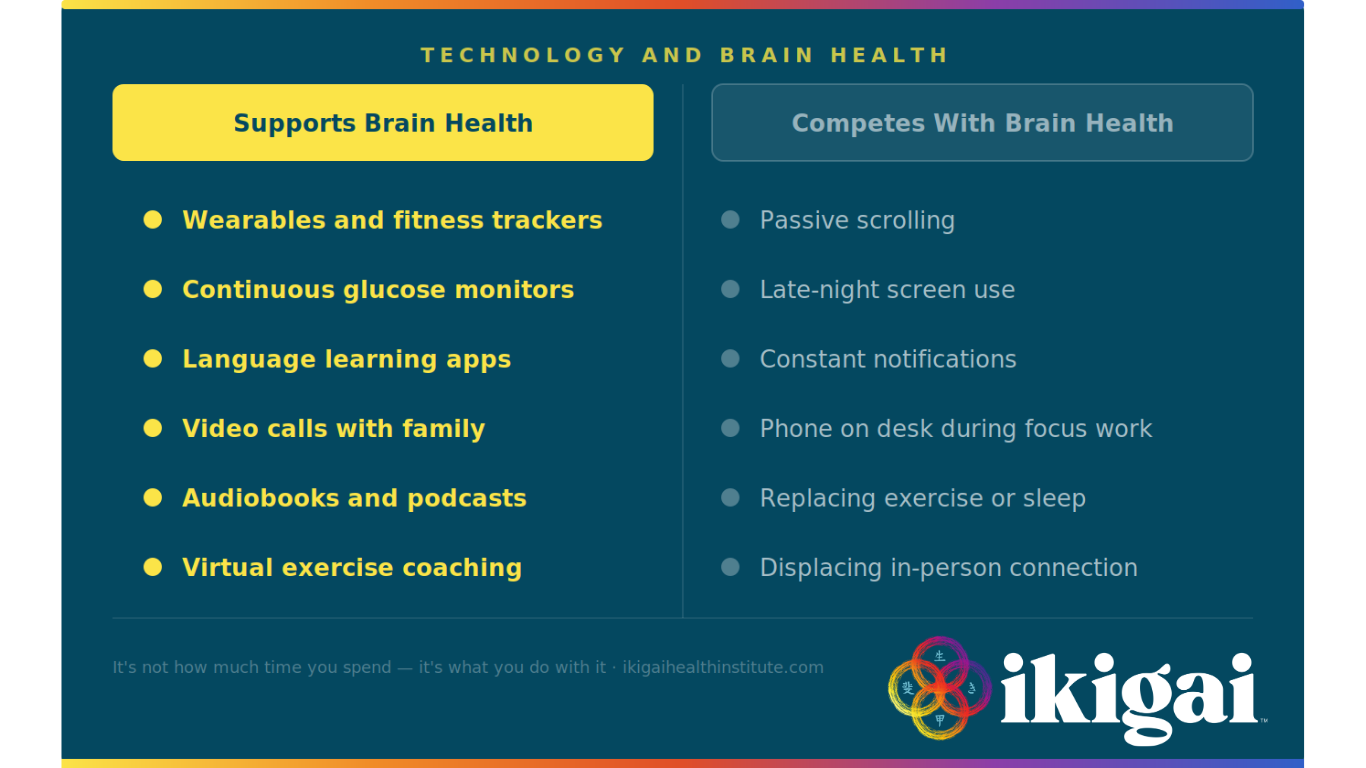
Technology has transformed medicine, education, and communication in ways that have likely improved both health and quality of life. Video calls allow grandparents to remain closely connected with grandchildren living across the country. Wearable devices encourage physical activity, monitor heart rhythms, and help identify sleep disorders. Hearing aids continue to become more sophisticated, helping preserve one of the largest modifiable risk factors associated with cognitive decline. Continuous glucose monitors provide real-time insight into metabolism, while online courses, language-learning platforms, podcasts, and digital libraries have made lifelong learning more accessible than ever before.
At Ikigai, we embrace many of these technologies. We routinely use continuous glucose monitors, wearable fitness devices, and remote exercise platforms because they help patients better understand their health and make meaningful changes. Technology is not something to fear. Used thoughtfully, it can become a powerful ally in the pursuit of better health.
The challenge is not technology itself. The challenge is ensuring that technology supports the activities we already know promote healthy brain aging rather than quietly replacing them.
Making Technology Work for Your Brain
One of the most consistent findings across brain health research is that the habits associated with healthy cognitive aging are remarkably timeless. Regular physical activity, restorative sleep, meaningful social relationships, intellectual curiosity, stress management, and cardiovascular health continue to have far stronger evidence supporting long-term brain health than any individual app, wearable device, or online program.
Technology works best when it reinforces these habits rather than competing with them. A smartwatch that motivates you to take a walk, a language-learning app that challenges your mind, or a video call that strengthens family relationships all use technology to support brain health. Endless passive scrolling that displaces exercise, reading, sleep, or face-to-face conversation may gradually crowd out the very activities that help our brains thrive.
Protecting sleep is particularly important. Using screens late into the evening or continuing to scroll in bed can delay sleep, reduce sleep quality, and make it more difficult for the brain to perform the overnight processes that consolidate memory and support long-term cognitive health. We explored exactly why in our post on sleep and brain health — one of the most powerful investments you can make in your long-term cognitive function.
This perspective also helps explain why studies looking at overall "screen time" often reach very different conclusions. Two people may each spend four hours a day using technology, yet have dramatically different experiences. One might be learning a new language, participating in an online book club, exercising with a virtual coach, or video chatting with grandchildren. Another may spend those same four hours passively scrolling through an endless stream of short videos. A large prospective cohort study published in the American Journal of Preventive Medicine in 2026, following 20,811 adults over 19 years, found that replacing one hour per day of mentally passive sedentary activity with mentally active sedentary behavior was associated with a 7% lower risk of developing dementia over nearly two decades of follow-up. In other words, what we do with technology — and what it replaces — may matter more than the number of hours we spend using it.
Small changes can also help protect focused attention. Consider silencing notifications that are not truly necessary, setting aside uninterrupted periods for reading or focused work, and keeping your phone out of sight during conversations or activities that require concentration. Use technology to encourage movement, learning, and connection rather than allowing it to become the default way to fill every quiet moment.
Attention Is a Choice
Technology has become one of the greatest tools humanity has ever created. It allows us to communicate across continents, learn almost any skill, monitor our health in real time, and access more information than previous generations could have imagined. There is little evidence that technology itself is causing dementia, and many digital innovations are improving both health and quality of life.
What technology cannot do is change the basic biology of the human brain. Our attention remains finite. Every day, we decide — consciously or not — where that attention will go. Some technologies encourage us to learn, connect, move, and grow. Others compete for our attention simply because holding it has become valuable.
The goal is not to fear technology or abandon it. It is to use it with intention. The healthiest relationship with technology is not defined by how many hours we spend in front of a screen, but by whether those hours support the life we want to live. If technology helps us become healthier, more curious, more connected, and more engaged with the people around us, it is serving us well. If it consistently distracts us from those same goals, it may be time to reclaim one of our brain's most precious resources — our attention.
Take the Next Step
At Ikigai, we assess the full picture of brain health — including how daily habits, lifestyle factors, and metabolic health interact to shape long-term cognitive resilience. If you're interested in understanding where your greatest opportunities lie, we'd welcome a conversation.
Schedule a Brain Health Consultation — Build a personalized strategy for long-term cognitive resilience.
Join the Ikigai Newsletter — Get our Brain Health Series and longevity insights delivered to your inbox.
Explore Our Programs — See how Ikigai integrates brain health, metabolic assessment, and lifestyle optimization into your care.
Recommended Reading
Brain Health Is Built, Not Found — The foundational framework for long-term cognitive resilience.
Sleep and Brain Health — Why technology's biggest threat to the brain may be what it does to sleep quality.
Social Connection and Brain Health — Why meaningful human connection — not virtual substitutes — supports cognitive resilience.
Exercise and Brain Health — The timeless intervention that no app has replicated.
Chronic Stress and Brain Health — How a constantly stimulated, interrupted mind may amplify cognitive stress over time.
Dementia Risk Factors: What You Can Control — The 14 modifiable risk factors with the strongest evidence for long-term brain protection.
Can Hearing Aids Reduce Dementia Risk? — One technology that does have strong evidence for cognitive protection.
Nutrition and Brain Health — Why what you eat shapes the metabolic environment your brain operates in.
The information in this post is for educational purposes only and is not intended as medical advice. Always consult with a physician before beginning any new health protocol.
