
Chronic Stress and Brain Health: How Stress Accelerates Cognitive Aging
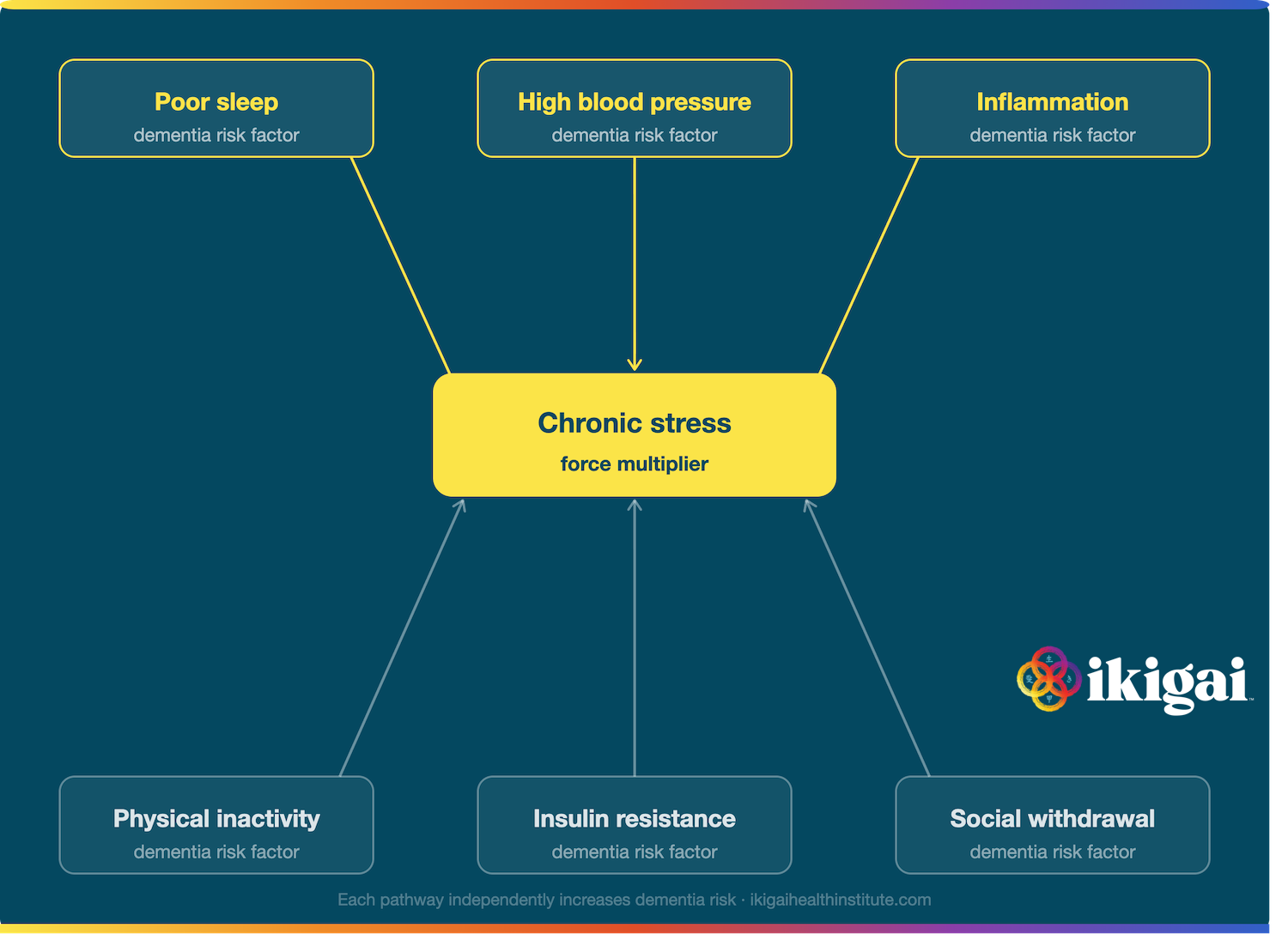
Does chronic stress affect brain health? Yes — and it may be one of the most underappreciated factors in long-term cognitive aging. Chronic stress doesn't just affect mood. It disrupts sleep, raises blood pressure, promotes insulin resistance, increases inflammation, and drives social withdrawal — each of which independently contributes to cognitive decline and dementia risk. Chronic stress doesn't appear to cause dementia directly; rather, it acts as a force multiplier that amplifies many of the biological conditions that accelerate brain aging. The encouraging finding is that our ability to respond to stress — our resilience — can be strengthened over time.
What's in this post?
Stress is not always the enemy: Why short-term stress differs from chronic activation.
What chronic stress does to the brain: Cortisol, the hippocampus, and structural changes.
The indirect effects: How stress amplifies other dementia risk factors.
Mental health is brain health: Depression, anxiety, and cognitive decline.
Resilience matters more than stress elimination: Why how you respond matters as much as what you experience.
What you can do: Evidence-based strategies to protect your brain.
Stress and the Brain: More Connected Than Most People Realize
When most people think about protecting their brain as they age, they think about puzzles, supplements, or perhaps a family history of Alzheimer's disease. Far fewer think about stress.
Yet chronic stress may be one of the most overlooked factors influencing long-term brain health and dementia risk.
The 2024 Lancet Commission estimated that up to 45% of dementia cases may be preventable or delayed through modification of known risk factors. While chronic stress itself is not one of the 14 identified modifiable risk factors, it influences many of them — including depression, poor sleep, physical inactivity, social isolation, hypertension, and metabolic dysfunction. In that sense, chronic stress may act less as an isolated risk factor and more as a force multiplier that amplifies other threats to long-term brain health.
Most people can identify periods in their lives that felt stressful. A demanding job, caring for aging parents, financial uncertainty, relationship challenges, or a personal health crisis can all place significant demands on the mind and body. That stress is not abnormal — it is an expected response to difficult circumstances. The concern arises when the body's stress response remains activated for months or years without adequate opportunities for recovery.
This distinction matters because chronic stress affects far more than mood. Fortunately, our ability to respond to stress can be strengthened over time — much like physical fitness.
Stress Is Not Always the Enemy
Stress itself is not inherently harmful. Short periods of stress are part of a healthy physiological response. When faced with a challenge, the body releases hormones such as adrenaline and cortisol. Heart rate increases, attention sharpens, and energy becomes more readily available. These responses helped our ancestors survive immediate threats and continue to help us perform under pressure today.
The problem is not stress itself, but the inability to turn the stress response off. Modern stressors are often very different from the acute threats humans evolved to handle. Financial concerns, work demands, caregiving responsibilities, health issues, and the constant stream of information from phones and computers can create a state of ongoing psychological stress. When that state persists for months or years, the body's stress response can become chronically activated.
A difficult week at work, preparing for a major presentation, or training for an athletic event is unlikely to harm your brain. The concern is chronic activation of the stress response month after month and year after year without adequate recovery. Over time, that chronic activation may contribute to many of the same biological processes associated with accelerated brain aging.
What Chronic Stress Does to the Brain
Researchers have spent decades studying the effects of chronic stress on the brain. Much of that work has focused on cortisol — the body's primary stress hormone. Cortisol is essential for normal function, helping regulate metabolism, immune function, blood pressure, and the body's response to challenges. Problems arise when elevated cortisol becomes the norm rather than the exception.
Areas of the brain involved in memory, learning, emotional regulation, and decision-making appear particularly sensitive to prolonged stress exposure. Studies have demonstrated structural and functional changes in regions such as the hippocampus and prefrontal cortex — areas that play important roles in memory formation and executive function. Some research has also found associations between chronically elevated cortisol levels and lower brain volume as well as poorer performance on certain cognitive tasks.
That does not mean stress inevitably causes dementia. Brain health is influenced by many factors — including genetics, vascular health, metabolic health, sleep quality, physical activity, and social engagement. Rather, the evidence suggests that chronic stress may contribute to an environment that makes healthy brain aging more difficult. Like many risk factors, it appears to exert its greatest influence through cumulative effects over time.
The Indirect Effects May Be Even More Important
Researchers increasingly recognize that risk factors rarely operate in isolation. The conditions that shape brain aging tend to cluster together, influencing and reinforcing one another over time. In many ways, this may be where chronic stress exerts its greatest influence.
People under significant stress often sleep less, exercise less, experience declines in overall dietary quality, drink more alcohol, and spend less time engaging socially. Stress can also contribute to higher blood pressure, insulin resistance, weight gain, and systemic inflammation. None of these changes occur in a vacuum, and many of them are already recognized as important contributors to cognitive decline and dementia risk.
Poor sleep has been associated with impaired memory and increased dementia risk. Hypertension is one of the leading modifiable risk factors for cognitive decline. Metabolic dysfunction, including insulin resistance and type 2 diabetes, is increasingly recognized as an important contributor to brain aging. Physical inactivity and social isolation have also been linked to poorer cognitive outcomes later in life.
Viewed through this lens, chronic stress acts less like a single risk factor and more like a force multiplier. It can worsen several of the very conditions that researchers believe have the greatest influence on long-term cognitive health.
Mental Health Is Brain Health
For years, mental health and brain health were often discussed as though they were separate concerns. Increasingly, researchers understand that they are deeply connected.
Conditions such as depression and anxiety affect far more than mood. They influence sleep quality, concentration, memory, motivation, physical activity, social engagement, and overall quality of life. Many people experiencing depression report difficulty focusing, slower thinking, forgetfulness, or challenges with decision-making — symptoms that carry implications for long-term cognitive health.
Researchers have observed associations between depression — particularly during midlife and later life — and an increased risk of future cognitive decline. The relationship is complex and likely bidirectional. Depression may contribute to cognitive decline in some individuals, while early changes in brain function may contribute to depression in others. Reflecting the growing strength of the evidence, the 2024 Lancet Commission now recognizes depression as a modifiable midlife risk factor for dementia.
Regardless of the direction of the relationship, the implication is clear. Mental health deserves attention. Addressing symptoms of depression, anxiety, burnout, or chronic emotional distress is not simply about improving quality of life today. It may also represent an important investment in future cognitive health.
Resilience Matters More Than Stress Elimination
Faced with evidence linking chronic stress to poorer health outcomes, it is tempting to conclude that the goal should be eliminating stress altogether. For most of us, however, that is neither realistic nor desirable. Life will always include challenges, setbacks, uncertainty, and periods of increased demand. The more useful goal is resilience.
Perhaps the most encouraging finding from this area of research is that stress does not affect everyone equally. Two people can experience similar circumstances and have very different outcomes. Increasingly, evidence suggests that the ability to adapt, recover, and maintain perspective may influence not only emotional well-being, but long-term cognitive health as well.
Resilience is not something people either have or do not have. It is a skill that can be developed over time through habits, relationships, and intentional practice.
Emerging research suggests that individuals with stronger stress-coping skills may accumulate less tau pathology — one of the hallmark proteins associated with Alzheimer's disease. Other studies suggest that adaptive coping strategies may help preserve cognitive function even when underlying Alzheimer's-related changes are present. How we respond to stress may matter just as much as the stress itself.
What You Can Do to Protect Your Brain
While no single intervention eliminates stress, several strategies consistently appear in the scientific literature and align with what we know about healthy brain aging.
Prioritize sleep. Sleep is one of the most powerful tools available for stress recovery. Poor sleep increases stress sensitivity, while chronic stress often disrupts sleep quality — a cycle that can be difficult to break. Roughly seven to eight hours appears optimal for most adults, and sleep quality matters as much as duration. If you snore, feel excessively tired during the day, or suspect sleep apnea, seek evaluation. We covered the brain science of sleep in detail in our sleep and brain health post.
Exercise regularly. Physical activity remains one of the most effective ways to improve mental health, cognitive health, and long-term brain resilience. Large studies suggest that regular physical activity is associated with approximately a 25% lower risk of developing dementia. Exercise helps regulate stress hormones, improves mood, enhances sleep quality, supports cardiovascular health, and stimulates pathways involved in neuroplasticity. As we explored in our post on exercise and brain health, these benefits are relevant at every age and don't require becoming an endurance athlete.
Strengthen social connections. Social isolation is now recognized as a modifiable risk factor for dementia, while strong social networks appear to support cognitive resilience throughout life. Researchers believe social engagement may challenge the brain in unique ways — requiring communication, emotional regulation, memory, and adaptability. Investing in friendships, family relationships, community involvement, or shared activities may be just as important for long-term brain health as many traditional medical interventions.
Manage metabolic and cardiovascular health. Stress management should not be viewed separately from overall health. Monitoring blood pressure, maintaining a healthy body composition, improving insulin sensitivity, exercising regularly, and following a nutrient-dense diet all help create a healthier environment for the brain. As we outlined in our vascular health and brain health post, the conditions that protect the cardiovascular system largely protect the brain as well.
Seek help when needed. Persistent anxiety, depression, burnout, or overwhelming stress should not be ignored. Working with a physician, psychologist, counselor, or psychiatrist can provide valuable tools and support. Seeking help is not a sign of weakness. It is a proactive step toward protecting both mental well-being and long-term cognitive health.
Building a More Resilient Brain
Life will always contain stress. The goal is not to eliminate every challenge, avoid every difficult conversation, or create a perfectly calm existence. The goal is to build the habits, relationships, and resilience that allow us to respond effectively when stress inevitably occurs.
Chronic stress affects far more than mood. It can influence sleep, cardiovascular health, metabolic function, physical activity, social engagement, and mental health — many of the same factors that shape long-term cognitive health and dementia risk.
But many of these pathways are modifiable.
By prioritizing sleep, exercise, meaningful relationships, mental health, and overall metabolic resilience, you are not only improving how you feel today. You may also be helping your brain remain healthier, sharper, and more resilient for decades to come.
Take the Next Step
Stress, mental health, and cognitive resilience are part of a comprehensive brain health strategy. At Ikigai, we assess the full picture — metabolic health, cardiovascular risk, sleep quality, and lifestyle factors — to identify where your greatest opportunities for long-term protection lie.
Schedule a Brain Health Consultation — Build a personalized strategy for long-term cognitive and mental resilience.
Join the Ikigai Newsletter — Get the full Brain Health Series and actionable longevity insights delivered to your inbox.
Explore Our Programs — See how Ikigai integrates brain health, metabolic assessment, and lifestyle optimization into your care.
Recommended Reading
Brain Health Is Built, Not Found — The foundational framework for long-term cognitive resilience.
Dementia Risk Factors: What You Can Control — The 14 modifiable risk factors linked to nearly half of all dementia cases.
Sleep and Brain Health — Why sleep is one of the most important and underappreciated tools for brain protection.
Exercise and Brain Health — How movement protects cognitive function through multiple overlapping pathways.
Insulin Resistance and Brain Aging — How metabolic dysfunction creates a brain energy gap long before symptoms appear.
Vascular Health and Brain Health — Why the conditions that protect your heart also protect your brain.
Can Hearing Aids Reduce Dementia Risk? — Another underappreciated modifiable risk factor from the Lancet Commission list.
A Look Ahead
Next in the Brain Health Series, we'll explore social connection — one of the most underappreciated and most powerful protective factors for cognitive health. Why isolation accelerates brain aging, what the research shows, and how we think about it at Ikigai.
