
Normal vs. Optimal Lab Ranges: Why "Normal" Isn't the Goal
What is the difference between normal and optimal lab ranges? A normal lab range simply identifies where most people in a population fall — including people who are overweight, insulin resistant, or sedentary. An optimal range identifies the level associated with the lowest long-term risk of disease in large population studies. The two are often different, sometimes significantly so. At Ikigai, we evaluate both: whether a result falls within a standard reference range, and where it sits relative to the levels associated with the best long-term health outcomes.
What's in this post?
The problem with average: Why population averages reflect what's common, not what's optimal.
A measurement most people have never heard of: What grip strength reveals about long-term mortality risk.
Where labs fit in: Normal vs. optimal for glucose, ApoB, and blood pressure.
Looking beyond a single number: Why trends matter more than any one result.
A different goal: What we're actually optimizing for.
Why "Normal" Isn't the Goal
Imagine you're planning for retirement.
You sit down with a financial advisor and ask how much money you'll need to retire comfortably. The advisor replies: "The average American your age has about this much saved."
Would that answer satisfy you?
Probably not. The average tells you what is common. It doesn't tell you what is sufficient. It doesn't tell you what will allow you to live the life you want twenty or thirty years from now.
Yet we make this mistake with our health all the time. Your cholesterol is normal. Your blood pressure is normal. Your blood sugar is normal. Your weight is normal. Everything looks fine.
But normal compared to whom?
The Difference Between Disease and Health
Modern medicine is remarkably good at identifying disease. If you have pneumonia, a broken bone, appendicitis, or advanced diabetes, the healthcare system is extraordinarily effective.
But disease and health are not the same thing.
Most chronic diseases don't appear overnight. Atherosclerosis develops over decades. Insulin resistance develops over years. Loss of muscle mass begins long before someone becomes frail. The biological changes associated with Alzheimer's disease often begin years before the first noticeable memory symptoms.
By the time a diagnosis appears, the process has usually been underway for quite some time.
This is where preventive medicine becomes different. The question is no longer whether you have disease today. The question becomes: what direction are you heading?
The Problem With Average
One reason this distinction matters is that many of the values we use in medicine are compared against population averages or reference ranges. Those ranges serve an important purpose. They help identify abnormalities and disease.
But they don't always identify the levels associated with the best long-term health outcomes.
This distinction becomes particularly important when we consider the health of the population from which many of these reference ranges and averages are derived. Despite spending more on healthcare than any nation in the world, only a small minority of American adults meet criteria for ideal cardiovascular health. Rates of obesity, insulin resistance, metabolic dysfunction, hypertension, and physical inactivity remain extraordinarily high.
If the population becomes less healthy, population averages move with it. The average becomes a description of what is common — not necessarily what is desirable.
That doesn't make population averages useless. It simply means we should be careful not to confuse "average" with "optimal."
Consider physical fitness. The average 45-year-old American has a VO₂ max that is dramatically lower than what we would consider ideal for long-term health and longevity. No one would argue that average fitness is the goal.
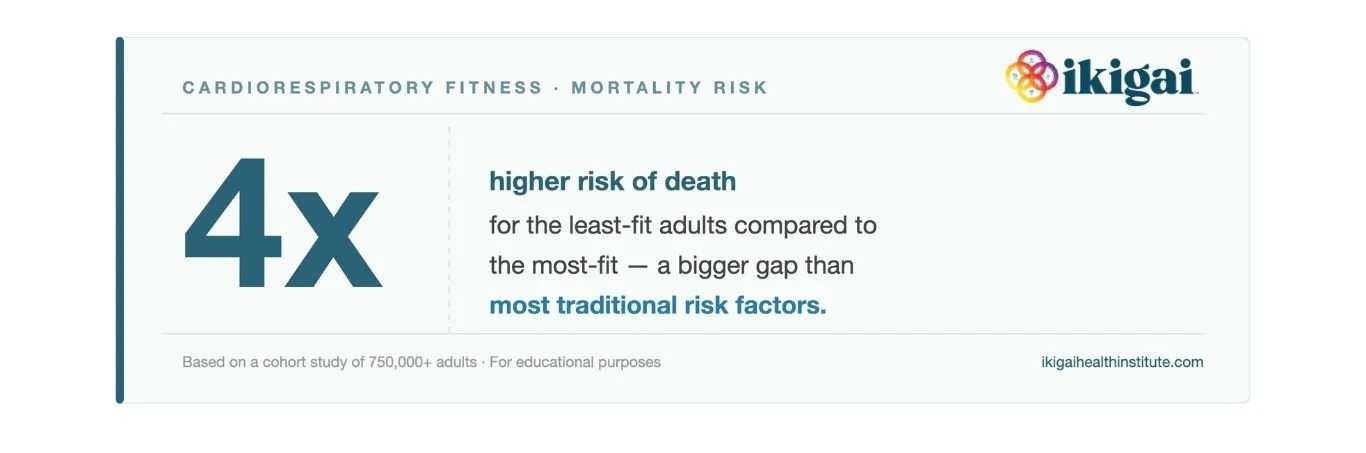
In fact, some of the strongest data in preventive medicine show that higher cardiorespiratory fitness is associated with lower rates of cardiovascular disease, disability, cancer mortality, and premature death. In a study of more than 750,000 adults, the least-fit individuals had approximately four times the risk of death compared with the most-fit individuals — a difference greater than many traditional cardiovascular risk factors.
Average fitness may be common. It is not optimal.
A Measurement Most People Have Never Heard Of
Now consider grip strength. Most people have never measured it, and most physicians never discuss it. Yet grip strength is one of the strongest predictors of future disability, loss of independence, and mortality that we have.
In a study of more than 500,000 adults, every 5-kilogram decrease in grip strength was associated with a 16–20% increase in the risk of death from any cause.
Individuals with greater strength tend to live longer, remain independent longer, and maintain higher levels of function as they age. That's not because grip strength itself is magical. Rather, it reflects something much larger: muscle mass, physical capacity, resilience, and the ability to withstand the inevitable challenges of aging.
Again, the goal is not to be average. The goal is to preserve the physical capacity needed to do the things that matter most to you.
Where Labs Fit In: Normal vs. Optimal Ranges
The same concept applies to many laboratory values.
This is where the conversation can become confusing. At Ikigai, we are not suggesting that laboratory reference ranges are wrong. They are useful, evidence-based, and necessary. But they answer a different question than many patients assume.
A laboratory reference range generally tells us whether a value is common within a population. What patients often want to know is something different: what level is associated with the lowest risk of future disease? This is one reason you may occasionally hear us discuss not only whether a value falls within a laboratory reference range, but also where it sits relative to levels associated with the lowest long-term risk in large population studies.
Those are not always the same thing.
A fasting glucose of 98 mg/dL may be considered normal. That does not mean it carries the same future risk as a fasting glucose of 82 mg/dL. Research has shown that diabetes risk begins to rise long before fasting glucose reaches the diabetic range.
An ApoB value may fall within a laboratory reference range while still leaving substantial room for cardiovascular risk reduction. We discussed ApoB's role in cardiovascular risk and prevention in an earlier post on what drives atherosclerosis.
A blood pressure may not meet the definition of hypertension while still being higher than ideal for long-term vascular health.
Risk exists on a continuum. Biology rarely works in neat categories.
This distinction is particularly important because many laboratory reference ranges are derived from large populations. In a country where obesity, insulin resistance, metabolic dysfunction, and sedentary behavior are extraordinarily common, "normal" does not always mean "associated with the best long-term health outcomes."
Sometimes it simply means common.
Looking Beyond a Single Number
Another limitation of traditional healthcare is that it often focuses on a single snapshot in time. A result may be normal today. But what if it has been moving steadily in the wrong direction for five years?
That trend may tell us more than the individual value itself.
A person whose fasting glucose has risen from 82 to 88 to 94 to 99 over several years may still receive a reassuring report each time. We have several patients just like this in our practice. Yet the trajectory tells a different story. The same is true for blood pressure, visceral fat, fitness, strength, and many other measures of health.
At Ikigai, we spend as much time evaluating trends as we do evaluating individual results. In many cases, the direction of travel is more important than the destination itself.
A Different Goal
The goal is not to chase perfect laboratory values. The goal is not to obsess over every measurement. And the goal is certainly not to create anxiety around normal results. The goal is to understand what those measurements mean for your future.
Will you be strong enough to travel, hike, play golf, ski, or lift your grandchildren at age 80? Will your brain remain resilient? Will your cardiovascular system continue to support the life you want to live? Those questions matter long before a diagnosis appears.
That is why we measure VO₂ max. That is why we assess strength and body composition. That is why we monitor blood pressure, metabolic health, and cardiovascular risk. And that is why we sometimes discuss not only what is normal, but what may be optimal.
Because average was never the goal.
The goal is preserving the strength, vitality, cognition, and independence to live the life you want for as long as possible.
Take the Next Step
Understanding where your numbers fall within a reference range is only half the picture. At Ikigai, we evaluate your labs against the levels associated with the best long-term outcomes — not just the levels that avoid a diagnosis.
Schedule a Consultation — Get a personalized assessment of where your biomarkers stand relative to optimal, not just normal.
Join the Ikigai Newsletter — Get our Insights articles delivered to your inbox.
Explore Our Programs — See how Ikigai integrates advanced diagnostics and trend-based monitoring into your care.
Recommended Reading
What Drives Atherosclerosis? — Why an ApoB result inside the reference range may still carry meaningful cardiovascular risk.
VO₂ Max: Your Ultimate Longevity Predictor — Why cardiorespiratory fitness is one of the strongest predictors of survival.
High Blood Pressure and Arterial Stiffness — How vascular age can diverge from a "normal" blood pressure reading.
Insulin Resistance and Long-Term Risk — Why a "normal" fasting glucose doesn't rule out rising metabolic risk.
Longevity Care vs. Functional vs. Integrative Medicine — How Ikigai's model compares to other approaches to optimization.
The information in this post is for educational purposes only and is not intended as medical advice. Always consult with a physician before beginning any new health protocol.
