
Social Connection and Brain Health: Purpose, Engagement, and Cognitive Aging
Does social connection affect brain health? Yes — and the evidence is more consistent than many people realize. Large observational studies find that individuals with stronger social engagement experience lower rates of cognitive decline and dementia over time. Social isolation is now recognized by the 2024 Lancet Commission as one of 14 modifiable risk factors for dementia. Beyond risk reduction, purpose and lifelong cognitive engagement appear to build cognitive reserve — the brain's ability to continue functioning despite age-related change. These factors can't be measured with a blood test, but they deserve a place alongside blood pressure, sleep, and exercise in any serious conversation about long-term brain health.
What's in this post?
Social connection and brain health: What the research shows and why it matters.
Purpose as a brain health signal: Why a sense of meaning may protect cognition.
Cognitive engagement and cognitive reserve: How lifelong learning builds resilience.
Why the overlap matters: These factors rarely work in isolation.
What this means practically: Questions worth asking yourself.
Three Often Overlooked Keys to Brain Health
When most people think about protecting their brain, they think about exercise, nutrition, sleep, blood pressure, or genetics. Those are all important — and they have been the focus of much of this Brain Health Series.
Yet preserving cognitive health involves more than reducing the risk of Alzheimer's disease. Brain health also encompasses memory, attention, judgment, emotional well-being, processing speed, and the ability to remain independent and engaged throughout life. While preventing dementia is an important goal, maintaining cognitive vitality for decades before dementia would ever develop is equally important.
Many of the factors that influence long-term brain health are present years — if not decades — before symptoms appear. That is why longevity medicine places such a strong emphasis on prevention. As we outlined in our foundational post on brain health, cognitive resilience is built over a lifetime, not rescued at the point of diagnosis.
Social connection, purpose, and cognitive engagement present a different challenge than blood pressure, cholesterol, or glucose. They cannot be measured with a blood test or a scan, and they are difficult to study in randomized clinical trials. As a result, much of what we know comes from large observational studies that follow thousands of people over many years. These studies cannot prove cause and effect, but they identify patterns that appear remarkably consistent across different populations. When those observations are supported by biologically plausible mechanisms and align with what we understand about how the brain functions, they become difficult to ignore.
Social Connection and Brain Health
Humans are inherently social. Throughout most of history, our survival depended on families, communities, and close interpersonal relationships. It is perhaps not surprising, then, that researchers have increasingly turned their attention to the role social connection plays in healthy cognitive aging.
Much of the research has focused on two related but distinct concepts: social isolation and loneliness. Social isolation refers to the objective absence of regular social interaction or meaningful relationships. Loneliness describes the subjective feeling of being disconnected from others, even when people are physically present. The 2024 Lancet Commission identifies late-life social isolation — not loneliness — as one of 14 modifiable risk factors for dementia. At the same time, other large observational studies have found loneliness to be at least as important, and in some populations an even stronger predictor of cognitive decline. The relative contributions remain an active area of investigation, but the broader message has remained remarkably consistent: maintaining meaningful human connection appears to support healthy cognitive aging.
Large observational studies have found that individuals with stronger social engagement experience lower rates of cognitive decline and dementia over time. Importantly, these findings do not prove that social interaction itself prevents dementia. It is possible that healthier brains make it easier to maintain relationships, or that socially connected individuals are also more likely to exercise, eat well, remain physically active, and seek medical care. These factors are difficult to separate completely, which is why researchers appropriately describe the relationship as an association rather than proof of causation.
Even so, several biologically plausible explanations have emerged. Meaningful social interaction requires the brain to integrate memory, language, attention, emotional regulation, executive function, and the ability to interpret verbal and nonverbal cues simultaneously. A thoughtful conversation, participating in a group discussion, mentoring a colleague, or maintaining close friendships asks the brain to perform many complex tasks at once. Whether this directly protects the brain remains uncertain, but it represents one plausible explanation for why socially engaged individuals often demonstrate greater cognitive resilience later in life.
Social connection may also influence brain health through less direct pathways. Individuals who are socially connected often report lower levels of chronic stress, better sleep, greater physical activity, improved cardiovascular health, and healthier daily routines. They may be more likely to adhere to medications, attend preventive medical appointments, and recognize health problems earlier. None of these factors alone explains the relationship between social connection and cognitive health, but together they create an environment that is more favorable for healthy aging.
The practical takeaway is not that everyone needs a large social network or an endlessly busy social calendar. The goal is meaningful connection. A handful of close relationships, regular interaction with family or friends, participation in a community, or involvement in activities that foster genuine belonging may ultimately matter far more than the number of contacts stored in a phone.
Purpose as a Brain Health Signal
Purpose is one of those concepts that can feel difficult to define yet surprisingly easy to recognize. For some people it comes from meaningful work. For others it comes from family, faith, service, creativity, teaching, mentoring, volunteering, or pursuing a long-term goal. Whatever its source, purpose provides a reason to continue investing in one's health and remaining engaged with the world.
Although purpose cannot be measured as easily as blood pressure or cholesterol, it has been studied extensively. Across multiple large observational studies, individuals reporting a stronger sense of purpose consistently demonstrate approximately a 20–30% lower risk of developing cognitive impairment or dementia over time. These findings have been reproduced across several populations and remain significant even after accounting for many traditional dementia risk factors.
At the same time, it is important to recognize the limitations of this evidence. Because these studies are observational, they cannot prove that purpose itself prevents dementia. It is equally plausible that healthier brains allow people to maintain a stronger sense of purpose, or that purpose encourages healthier behaviors that ultimately protect the brain. Both explanations may be true.
Perhaps the most compelling aspect of purpose is not simply its association with dementia risk but the way it changes how people approach everyday life. Someone who has a meaningful reason to remain healthy is often more willing to exercise consistently, recover from setbacks, continue learning, nurture relationships, and make difficult lifestyle changes. In that sense, purpose is not separate from the other pillars of healthspan — it may be one of the factors that helps sustain them over decades, long after the initial motivation has faded.
Cognitive Engagement and Cognitive Reserve
The human brain is remarkably adaptable. Throughout life it continues to form new connections, strengthen existing neural networks, and reorganize in response to experience. This ability — often referred to as neuroplasticity — gradually declines with age, but it never disappears entirely.
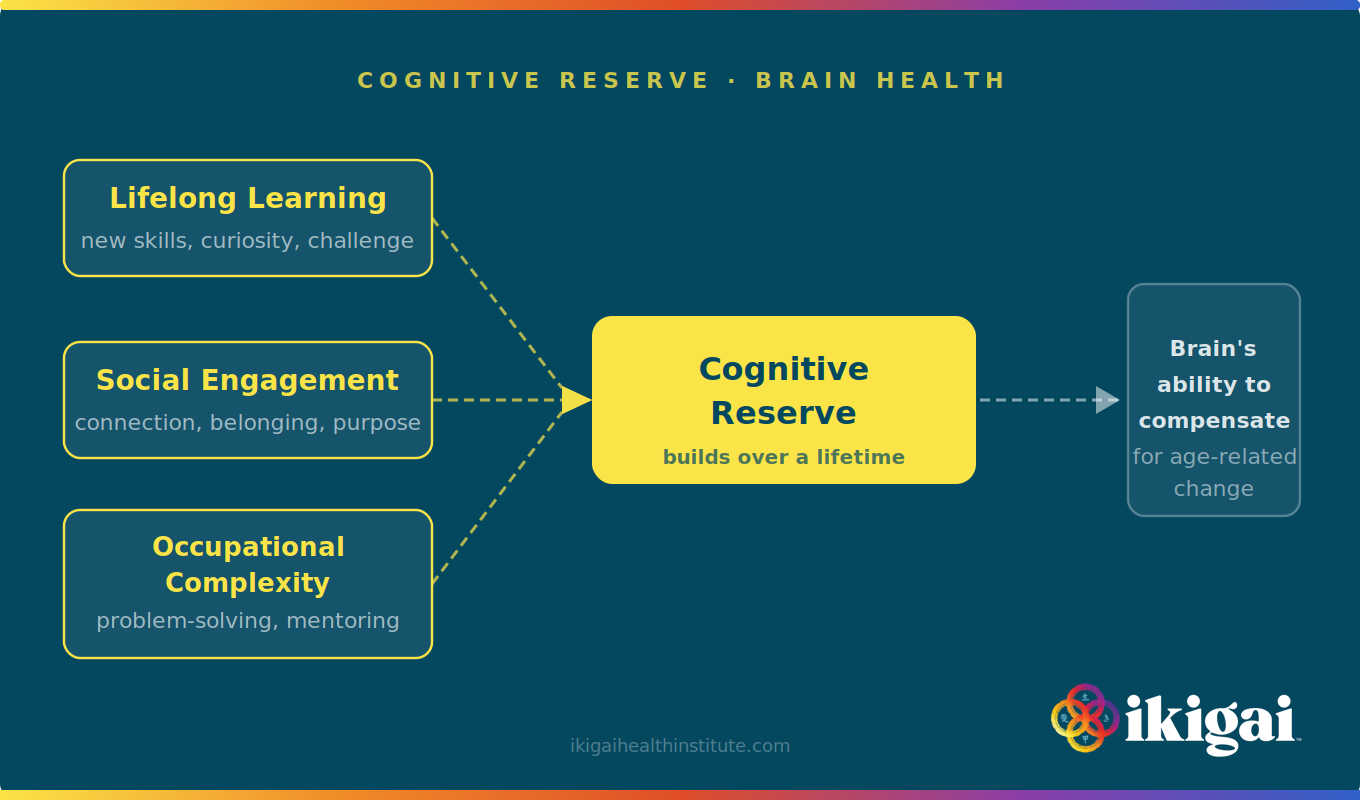
A related concept known as cognitive reserve has emerged as one of the more compelling theories in aging neuroscience. Cognitive reserve describes the brain's ability to continue functioning despite the accumulation of age-related changes or even underlying disease. Two individuals may have similar degrees of Alzheimer's pathology on brain imaging, yet experience very different levels of cognitive function during life. Researchers believe that differences in lifetime education, occupational complexity, social engagement, and mentally stimulating activities may help explain part of that difference — allowing the brain to compensate more effectively for injury or disease.
Large observational studies consistently support this idea. Individuals who remain cognitively engaged throughout life tend to experience lower rates of cognitive decline and dementia than those who are less mentally active. Activities such as reading, learning new skills, playing a musical instrument, speaking another language, solving complex problems, teaching, mentoring, and volunteering have all been associated with healthier cognitive aging. The common thread appears to be sustained mental engagement rather than passive routine.
It is important, however, to distinguish between lifelong cognitive engagement and short-term cognitive training. The observational evidence supporting cognitive reserve is substantial, but randomized trials evaluating individual brain-training programs have generally been less convincing in demonstrating prevention of dementia. That does not necessarily mean those programs are ineffective. Rather, it suggests that maintaining an intellectually curious, engaged life over decades is fundamentally different from completing a six-week computer-based training program. Lifelong habits are likely far more influential than any single intervention.
A more useful question than "should I buy a brain-training app" is this: does your life continue to require you to learn, adapt, create, solve problems, and occasionally feel like a beginner? Learning a new language, taking up photography, joining a book club, mastering unfamiliar technology, returning to school, writing, building something with your hands, or mentoring someone early in their career all ask the brain to develop new skills and strengthen existing networks.
Why the Overlap Matters
Social connection, purpose, and cognitive engagement are often discussed as separate concepts, but in everyday life they rarely exist independently. A book club provides opportunities to learn while fostering conversation and friendship. Volunteering creates purpose while introducing new challenges and strengthening community ties. Coaching youth sports, mentoring younger colleagues, participating in a faith community, joining a choir, or taking a continuing education course all combine multiple elements that appear to support healthy aging.
This overlap also illustrates one of the challenges researchers face. People who maintain close relationships often exercise more, sleep better, remain physically active, seek preventive healthcare, and maintain healthier lifestyles overall. Likewise, individuals with a strong sense of purpose are frequently more willing to invest in the daily behaviors that preserve long-term health. Because these factors tend to cluster together, it can be difficult to determine exactly how much benefit comes from any one behavior alone.
Yet that complexity also reinforces one of the central principles of longevity medicine: health behaviors rarely work in isolation. They create a network of reinforcing habits that collectively influence long-term health and cognitive resilience. As we've seen throughout this series — with exercise, sleep, nutrition, vascular health, and stress — the greatest benefits occur when multiple systems are improved simultaneously.
Perhaps that is also one reason these activities become sustainable. Few people maintain relationships, keep learning, or volunteer for decades simply because a study suggested it might reduce dementia risk. They continue because those activities enrich their lives, provide fulfillment, and contribute to who they are. Brain health, in other words, becomes a byproduct of living a life that remains active, connected, and meaningful.
What This Means Practically
For our patients, these findings encourage us to think about brain health more broadly than laboratory values or imaging studies alone. We routinely discuss blood pressure, cholesterol, sleep, hearing, exercise, nutrition, and metabolic health because they remain essential. Increasingly, however, we ask a different set of questions as well:
Who are the people you spend time with?
What gives your days structure and meaning?
Where are you continuing to learn?
What challenges you intellectually?
What role do you play in the lives of others?
The answers will be different for every person, but the underlying principle is consistent. The brain appears to thrive when it is regularly used in meaningful ways. That does not require extraordinary accomplishments or constant productivity. It may simply mean nurturing close friendships, volunteering in your community, taking a class, mentoring someone younger, learning a musical instrument, joining a discussion group, or making time for activities that require sustained attention and curiosity.
For many people, choosing one new activity that combines more than one of these domains is an excellent place to start. A volunteer position may provide purpose, social interaction, and cognitive challenge simultaneously. Joining a hiking group encourages physical activity while building friendships. Taking a cooking class introduces new skills while creating opportunities for connection. Small, consistent investments in these areas are far more likely to influence long-term health than dramatic but short-lived bursts of motivation.
The Ikigai View
At Ikigai, we do not view brain health as the product of any single intervention. No single behavior determines how the brain ages. Cognitive health reflects the cumulative effects of many interacting factors over decades, and the most effective approach is almost certainly layered.
We continue to emphasize blood pressure control, cardiovascular health, metabolic health, sleep, hearing, exercise, nutrition, and the thoughtful use of evidence-based therapies because each contributes to reducing risk. Social connection, purpose, and cognitive engagement do not replace those pillars — they complement them.
Our name was chosen intentionally. Ikigai is a Japanese concept, often translated as "a reason for being" or "that which makes life worth living." While there is no evidence that simply finding one's ikigai prevents dementia, the philosophy captures something modern research increasingly suggests: healthspan is about far more than avoiding disease or extending life. It is about preserving the ability to remain connected, curious, capable, and engaged in the people and pursuits that give life meaning.
Ultimately, that is the goal of longevity medicine. We want to reduce the risk of Alzheimer's disease and other causes of cognitive decline — but we also want to preserve the richness of everyday life long before disease ever enters the picture. The objective is not simply to live longer. It is to arrive at those later years with the capacity to continue learning, contributing, building relationships, and fully participating in a life that remains deeply worth living.
Take the Next Step
Social connection, purpose, and cognitive engagement are part of a comprehensive brain health strategy. At Ikigai, we assess the full picture — metabolic health, cardiovascular risk, sleep quality, cognitive risk, and lifestyle — to identify where your greatest opportunities for long-term protection lie.
Schedule a Brain Health Consultation — Build a personalized strategy for long-term cognitive resilience.
Join the Ikigai Newsletter — Get the full Brain Health Series and actionable longevity insights delivered to your inbox.
Explore Our Programs — See how Ikigai integrates brain health, metabolic assessment, and lifestyle optimization into your care.
References
Recommended Reading
Brain Health Is Built, Not Found — The foundational framework for understanding how cognitive resilience is built over decades.
Dementia Risk Factors: What You Can Control — The 14 modifiable risk factors linked to nearly half of all dementia cases — including social isolation.
Chronic Stress and Brain Health — How chronic stress acts as a force multiplier on many of the same risk factors discussed here.
Exercise and Brain Health — Why physical activity remains one of the most powerful tools for cognitive resilience.
Sleep and Brain Health — How overnight brain maintenance supports the same cognitive functions social engagement protects.
Nutrition and Brain Health — Why metabolic health is the foundation on which all other brain health strategies depend.
Vascular Health and Brain Health — How protecting your blood vessels protects the cognitive functions that keep you connected and engaged.
How to Track Brain Health Before It Slips — The three-domain framework Ikigai uses to measure cognitive health proactively.
The information in this post is for educational purposes only and is not intended as medical advice. Always consult with a physician before beginning any new health protocol.
