

Does menopause affect brain health? Yes — and the science is revealing that menopause is far more than a reproductive transition. Estrogen plays an active role in brain metabolism, inflammation, blood flow, and synaptic function. As estrogen levels decline during the menopausal transition, the brain must adapt to a new hormonal environment. Researchers now believe menopause may not directly cause Alzheimer's disease, but it may reduce the brain's resilience — its ability to compensate for the many other processes that contribute to neurodegeneration over decades. The menopausal transition may represent one of the most important windows for investing in long-term brain health.
What's in this post?
- Understanding One of the Most Important Transitions in Women's Long-Term Brain Health
- More Than a Reproductive Hormone
- A New Way of Thinking About Menopause
- A Brain in Transition
- Resilience Matters
- What About Hormone Therapy?
- The Opportunity Hidden in Midlife
Understanding One of the Most Important Transitions in Women's Long-Term Brain Health
For decades, menopause was viewed primarily through the lens of reproductive health. More recently, scientists have begun looking at it through an entirely different lens: the brain.
That shift reflects one of the most important developments in Alzheimer's research. In our previous article, Why Alzheimer's Disease Disproportionately Affects Women, we explored why women account for nearly two-thirds of Alzheimer's cases and why longer life expectancy tells only part of the story. Here, we'll take the next step by examining what researchers are learning about the menopausal transition itself — and why it has become one of the most active areas of investigation in brain health.
The answers are still unfolding, but the questions themselves have changed dramatically. Menopause is no longer viewed simply as the end of reproductive function. It is increasingly recognized as an important neurologic transition that may influence how the brain ages over the decades that follow.
More Than a Reproductive Hormone
Estrogen is often thought of as the hormone responsible for fertility, menstrual cycles, and pregnancy. In reality, it plays an important role throughout the brain.
Estrogen receptors are found in regions responsible for memory, executive function, learning, and emotion — including the hippocampus and prefrontal cortex. There, estrogen helps neurons communicate efficiently, supports healthy synapses, promotes healthy blood flow, regulates inflammation, and helps brain cells produce the energy they need to function.
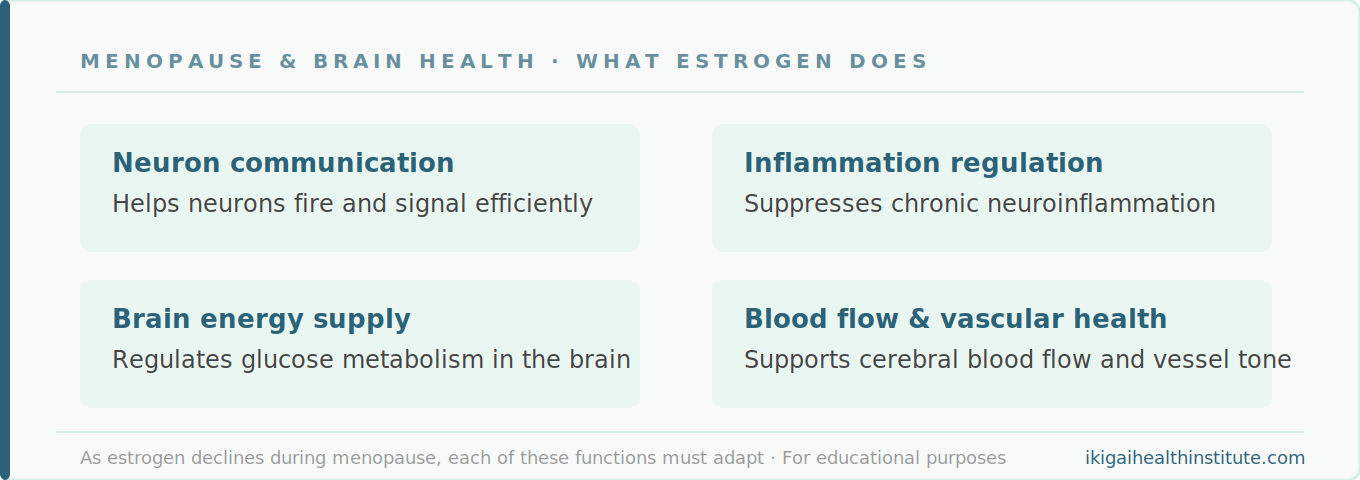
That last point may be especially important. Although the brain accounts for only about 2% of body weight, it consumes roughly 20% of the body's energy. Every memory, conversation, decision, and movement depends on a constant supply of glucose and oxygen. As we explored in our post on vascular health and brain health, even small disruptions in blood flow and metabolic support can affect brain performance — and over time, those disruptions compound.
As estrogen levels decline during menopause, the brain must adapt to a new metabolic environment. Like every organ, the brain has a remarkable capacity to adapt — what scientists increasingly describe as resilience. Understanding what strengthens or weakens that resilience has become one of the central goals of modern Alzheimer's research.
A New Way of Thinking About Menopause
Much of today's research reflects a fundamental shift in thinking. The question is no longer whether menopause directly causes Alzheimer's disease. There is little evidence that it does. Instead, scientists are investigating whether menopause represents a period during which the brain becomes more vulnerable to the many processes that contribute to neurodegeneration over decades.
That distinction may seem subtle, but it fundamentally changes how we think about brain health. Alzheimer's disease develops over years, often decades, through the interaction of genetics, vascular disease, metabolic dysfunction, chronic inflammation, sleep disorders, and many other factors. Menopause may not initiate those processes. It may simply reduce the brain's ability to compensate for them.
In other words, menopause may influence resilience more than it influences disease itself.
Not all menopausal transitions are the same. Women who undergo bilateral removal of the ovaries before reaching natural menopause experience an abrupt loss of estrogen rather than the gradual hormonal transition most women experience. Observational studies suggest this group may face a higher long-term risk of cognitive decline and dementia, although researchers are still working to understand exactly why.
A Brain in Transition
One reason scientists have become so interested in menopause is that advances in brain imaging now allow them to watch this transition unfold in real time. In studies using advanced PET imaging, researchers have observed changes in how some women's brains use glucose during perimenopause — particularly in regions involved in memory and higher-order thinking.
For many women, these changes appear to stabilize — or even partially recover — after menopause, suggesting the brain is adapting to a new hormonal environment rather than simply deteriorating.
These findings are exciting because they offer a biologically plausible explanation for why menopause has become such an important focus of Alzheimer's research. They are not, however, proof that menopause causes dementia. Rather, they suggest that this transition may represent a period of remodeling, during which the brain adjusts to changing hormone levels.
This is one reason research in this area has accelerated so rapidly over the past decade. Scientists are not chasing a fashionable idea — they are following a growing body of evidence pointing toward an important relationship between estrogen, brain metabolism, and long-term cognitive health.
Resilience Matters
One of the most important ideas emerging from modern Alzheimer's research is that brain health is determined by cumulative resilience rather than any single risk factor.
Imagine two women entering menopause at the same age. One arrives with healthy blood pressure, strong metabolic health, regular exercise habits, and restorative sleep. The other enters menopause with several of these risk factors already working against her. Both experience the same hormonal transition, but their brains may respond very differently — because they begin the journey with different levels of physiologic reserve.
Researchers increasingly believe this may help explain why Alzheimer's disease is so complex. Hormonal changes occur within the context of everything else happening in the aging brain. That perspective also explains why no single intervention is likely to prevent dementia. Protecting brain health requires addressing the entire landscape of risk.
What About Hormone Therapy?
If estrogen supports healthy brain function, an obvious question follows: should every woman receive hormone therapy to reduce Alzheimer's risk?
At this point, the evidence does not support that conclusion. Menopause is increasingly recognized as one piece of a much larger story involving genetics, vascular health, metabolism, sleep, and lifestyle. Hormone therapy remains an important area of investigation, but it is only one potential contributor to long-term brain health.
Several clinical trials have explored whether beginning hormone therapy near the onset of menopause produces different long-term outcomes than starting treatment years later. While these studies support the biologic plausibility of a "critical window," they have not produced evidence strong enough to recommend hormone therapy solely for Alzheimer's prevention.
Current medical guidelines continue to recommend that decisions about menopausal hormone therapy be individualized — based primarily on menopausal symptoms, overall health, cardiovascular risk, and personal preferences rather than Alzheimer's prevention alone. We'll explore that topic in much greater depth in our upcoming Hormone Health series.
The Opportunity Hidden in Midlife
The emerging science surrounding menopause should not be viewed as a reason for alarm. It should be viewed as a reminder that midlife is one of the most important opportunities to invest in long-term brain health.
If the brain is adapting to one of the largest hormonal transitions of adult life, then reducing every other source of physiologic stress becomes even more important. Exercise and cardiovascular fitness, metabolic health, restorative sleep, hearing preservation, intellectual engagement, and meaningful social connection all help strengthen the resilience that supports healthy cognitive aging. None of these interventions is independently sufficient. Together, they create an environment that allows the brain to adapt more successfully as it ages.
Researchers continue to refine our understanding of menopause and Alzheimer's disease, and many questions remain unanswered. What has changed is our perspective. Menopause is increasingly recognized as an important chapter in the story of brain aging — not because it determines a woman's future, but because it may influence how resilient her brain remains as it navigates the decades ahead.
Understanding that transition gives us something invaluable: the opportunity to act while the brain is still healthy. In future articles, we'll explore the specific lifestyle, metabolic, vascular, and medical strategies that can help preserve that resilience for years to come.
Take the Next Step
At Ikigai, we assess brain health and cognitive risk as part of a comprehensive longevity care plan — including the unique biological factors that affect women's risk. If you're navigating the menopausal transition and want to understand what it means for your long-term cognitive health, we'd welcome a conversation.
Schedule a Consultation — Build a personalized strategy for long-term cognitive and metabolic resilience.
Join the Ikigai Newsletter — Get our Brain Health Series and upcoming Hormone Health articles delivered to your inbox.
Explore Our Programs — See how Ikigai integrates brain health, metabolic assessment, and hormonal health into your care.
Recommended Reading
Why Alzheimer's Disease Disproportionately Affects Women — The companion piece to this article: why women carry a 2:1 lifetime risk and what biology has to do with it.
Brain Health Is Built, Not Found — The foundational framework for long-term cognitive resilience.
Vascular Health and Brain Health — Why the conditions that protect your blood vessels also protect your brain during and after menopause.
Insulin Resistance and Brain Aging — How metabolic dysfunction compounds the effects of hormonal change on the aging brain.
Sleep and Brain Health — Why restorative sleep becomes even more critical during and after the menopausal transition.
Exercise and Brain Health — One of the most powerful tools for preserving brain resilience at any age.
Dementia Risk Factors: What You Can Control — The 14 modifiable risk factors that shape long-term dementia risk — and how to address them.
Social Connection and Brain Health — Why meaningful relationships and purpose belong alongside medical risk factors in any serious brain health strategy.
The information in this post is for educational purposes only and is not intended as medical advice. Always consult with a physician before beginning any new health protocol.



Stop guessing. Start optimizing.
You have a strategy for your wealth and your career. It's time to build one for your health.