
What Early Cognitive Decline Looks Like — and When to Pay Attention
The question isn't whether your brain works like it did at 25. It's whether something has actually changed from the way it used to work for you. Isolated forgetful moments rarely mean much on their own — meaningful cognitive decline is about a persistent change from your own baseline, not a single bad day with your car keys.
What's in this post?
The comparison that matters is you: Why your own baseline matters more than the population average.
Normal aging changes the brain, too: What's expected to slow down — and what isn't.
It isn't always about memory: The other ways cognitive change can show up.
Function matters: What terms like MCI and dementia actually mean.
Sometimes someone else notices first: Why outside observations matter — and their limits.
Cognitive change has many possible explanations: Why a symptom isn't a diagnosis.
What happens when something really has changed: What a thoughtful workup actually looks like.
Why your baseline still matters: And why recognizing change still matters, too.
The Comparison That Matters Is You
This article is intended for education and is not a tool for diagnosing cognitive impairment or dementia. Many medical, psychological, medication-related, and lifestyle factors can affect memory and thinking. Cognitive changes need to be understood in the context of an individual's health, history, and previous level of function. This article addresses gradual changes that develop over months or years; it is not about sudden confusion or abrupt changes in thinking, which are a separate matter to raise directly with a medical professional.
Everyone forgets things. You can't remember the name of an actor you've seen in a dozen movies. You walk upstairs and briefly wonder why you went there. A word sits stubbornly on the tip of your tongue and arrives five minutes after you needed it. As we get older, processing speed can slow and retrieving information can take a little longer. None of that, by itself, means something is wrong.
We've spent much of this Brain Health series talking about preventing cognitive decline, which can have an unintended consequence: once you start thinking seriously about brain health, every forgotten name can suddenly feel ominous. Change from your own baseline — not the occasional lapse — is one of the most important concepts in understanding cognitive health.
Two 70-year-olds can have very different cognitive starting points, shaped by their education, occupations, abilities, experiences, and lifelong cognitive strengths. Someone who started at an unusually high level can experience meaningful decline and still perform within a population's "normal" range, while someone else may perform below average on a particular test without having declined at all. That's why the comparison that matters most isn't with everyone else your age. It's with yourself over time.
Maybe you've always been terrible with names. That's different from someone who remembered every name for 50 years and increasingly can't. Taking somewhat longer to work through a complicated financial problem isn't the same as becoming unable to manage finances you've handled independently for decades. Occasionally forgetting part of a conversation is different from repeatedly asking the same question because the conversation itself isn't sticking. This is why isolated moments are usually much less informative than patterns. Cognitive decline is generally about persistent change over time — not winning or losing today's battle with your car keys.
Normal Aging Changes the Brain, Too
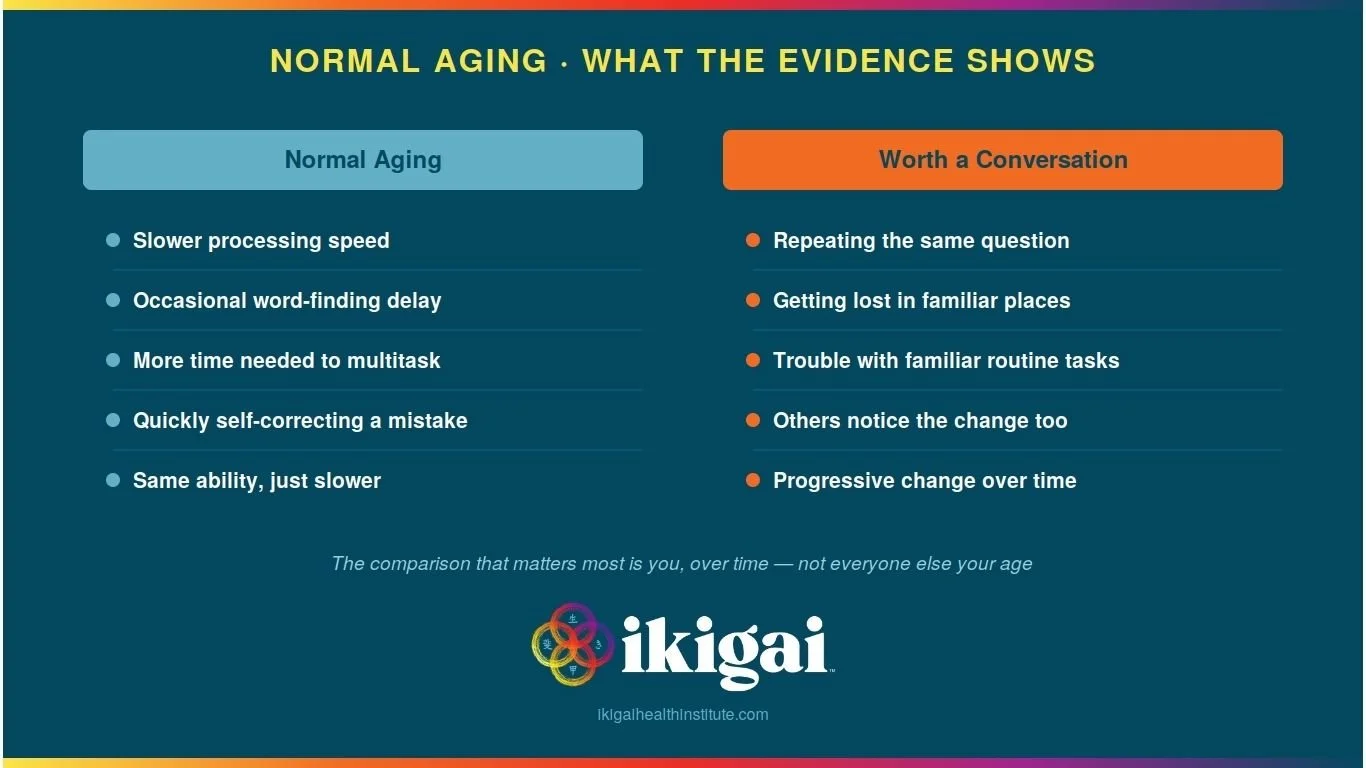
Some cognitive abilities do change as we age. Processing speed tends to slow. Multitasking may become more difficult. Retrieving a particular word or name may take longer, even though the information eventually comes back. A useful distinction is often whether the brain can still get where it needs to go.
You may need more time to absorb new information, shift between competing tasks, or retrieve something you know is there. You may rely more heavily on a calendar or make the occasional mistake you quickly recognize and correct. The process may be slower or less effortless than it once was, but the underlying ability remains intact. More concerning changes tend to be persistent, progressive, and increasingly different from how that person previously functioned. Repeatedly forgetting recently learned information, losing the thread of familiar tasks, becoming confused in previously familiar situations, or developing difficulties that begin to affect everyday function deserve a different level of attention.
There is no single trick that separates "normal" from "abnormal," which is precisely why symptom checklists can be misleading. Context, trajectory, and function matter more than whether you've experienced a particular forgetful moment.
It Isn't Always About Memory
We tend to use "memory" as shorthand for cognition, but the brain does much more than remember. Cognitive change can involve planning and organization, judgment, language, attention, navigation, visual processing, or behavior. Someone might increasingly struggle to organize a complicated project that was once routine. Another person may have unusual difficulty finding words, following conversations, navigating familiar places, or making decisions that previously came easily.
Memory problems are common in cognitive disorders, including Alzheimer's disease, but they aren't the only possible presentation — and cognitive change does not automatically mean Alzheimer's disease. There are many reasons thinking can change, which is why the first task is to understand what has changed rather than trying to attach a diagnosis to it ourselves.
Function Matters
Clinicians sometimes use terms such as subjective cognitive decline, mild cognitive impairment, and dementia to describe different clinical states. These aren't simply three stops on an inevitable journey. With subjective cognitive decline, a person perceives a persistent change even though testing does not demonstrate clear impairment. With mild cognitive impairment, or MCI, the difficulty can be measured, but the person remains substantially independent in daily life. Dementia crosses an important functional threshold: cognitive impairment has become significant enough to interfere with that independence.
The distinction is important, but so is what these labels do not tell us. MCI does not inevitably become dementia. Subjective cognitive decline does not inevitably become MCI. People can remain stable, improve, or have symptoms driven by conditions other than a progressive neurodegenerative disease. These categories describe where someone appears to be now. They aren't a prophecy about where that person is going.
Sometimes Someone Else Notices First
One of the more complicated features of cognitive change is that the person experiencing it isn't always the first person to recognize the pattern. A spouse may notice repeated questions. A colleague may notice that someone who once effortlessly managed complex projects is struggling to stay organized. An adult child may notice subtle changes in judgment or behavior during visits home. Information from people who know us well can therefore be valuable when clinicians are trying to understand whether something has truly changed.
But this cuts both ways. A worried spouse doesn't make a diagnosis. Relationships, anxiety, expectations, mood, and ordinary differences in perception can all influence what another person notices. The useful signal isn't "someone thinks I'm getting forgetful." It's a credible pattern of change, particularly when observations from other people line up with changes the individual or clinician can identify over time.
Cognitive Change Has Many Possible Explanations
This may be the most reassuring — and medically important — part of the conversation: noticing cognitive change does not tell you what is causing it. Poor sleep, depression, and anxiety can all affect attention, memory, and our ability to process information. Medications can interfere with cognition, particularly as medication lists grow longer, and alcohol and other substances can contribute as well. Clinicians may also consider medical problems such as thyroid disease or vitamin B12 deficiency, while hearing and vision loss can affect both cognitive performance and the way someone interacts with the world.
There are also neurologic causes, including Alzheimer's disease, cerebrovascular disease, Lewy body disease, frontotemporal degeneration, and others. Particularly later in life, more than one process can sometimes contribute. That's why jumping from "my memory seems worse" to "I must be developing Alzheimer's" isn't useful. The symptom is the beginning of the investigation, not the diagnosis.
What Happens When Something Really Has Changed?
A thoughtful evaluation usually begins with something decidedly low-tech: a conversation. What changed? When did it begin? Is it progressing? Has daily function changed? Has anyone else noticed? Sleep, mood, medications, hearing, vision, alcohol use, metabolic health, and other medical conditions all provide context.
From there, the evaluation depends on what that story reveals. Sometimes a cognitive assessment or basic medical evaluation provides enough information; other situations warrant neuropsychological testing, imaging, or more specialized testing. The point isn't to run every available test. It's to understand the pattern well enough to ask the right next question.
More testing isn't automatically better medicine. As increasingly sophisticated brain-health tests become available, that distinction matters even more: a test has value when it helps answer the right clinical question.
Why Your Baseline Still Matters
Earlier in this Brain Health series, we explained how we track brain health before it slips, including why we establish cognitive baselines and follow them over time. The reason becomes particularly clear when we're trying to understand change: if cognition is individual, knowing where someone started can provide context that a population average cannot.
But establishing a baseline isn't the same as searching healthy people for evidence of Alzheimer's disease. We assess cognitive performance and risk longitudinally; we don't routinely pursue specialized Alzheimer's biomarkers in people without a clinical reason to do so. Routine cognitive screening of asymptomatic adults has also not been shown to improve outcomes or established by current guidelines as a standard population-screening strategy. Our longitudinal approach reflects our clinical philosophy while recognizing where the evidence currently stands.
The important idea here isn't the testing itself. It's trajectory. When something feels different years later, having a starting point can help put that change into context.
Why Recognizing Meaningful Change Still Matters
If earlier isn't automatically better, why pay attention at all? Because meaningful cognitive change deserves an explanation. Sometimes the explanation is something treatable: poor sleep, medication effects, depression, a sensory problem, or another medical condition. An evaluation may also uncover cardiovascular, metabolic, or lifestyle risks that deserve greater attention. And sometimes it does identify a neurologic disease, creating opportunities for planning, safety discussions, support, clinical trials, or — in carefully selected patients with appropriately confirmed early Alzheimer's disease — consideration of newer disease-modifying therapies.
Modern medicine still has limitations. Not every cognitive problem can be neatly classified. Not every person with MCI progresses. Biomarkers can provide information without necessarily providing certainty about an individual's future. Current disease-modifying Alzheimer's treatments apply to a relatively specific group of patients, offer modest benefits, and carry meaningful risks. And information itself isn't always benign: a diagnosis — or even an uncertain finding — can carry a substantial emotional burden for patients and families. That's another reason testing should be undertaken thoughtfully rather than simply because it is available. Recognizing change matters; turning every cognitive lapse into a search for disease does not.
The Point Was Never to Spend Your Life Looking for Dementia
We've covered a lot of territory in this Brain Health series: exercise, metabolic health, vascular risk, sleep, nutrition, alcohol, stress, social connection, purpose, cognitive engagement, menopause, supplements, technology, and the practical work of putting those pieces together. None of it gives us complete control over what happens to our brains, but neither are we powerless.
The larger objective is to build and preserve cognitive reserve, reduce the risks we can influence, protect vascular and metabolic health, remain physically active, sleep well, stay socially and intellectually engaged, and pay attention to meaningful changes in our own trajectory. Brain health isn't about becoming hypervigilant every time you forget why you walked into the kitchen. It's about knowing yourself well enough to recognize when something has actually changed — and having enough perspective not to diagnose yourself when it does.
After an entire series about protecting the brain, that may be one of the most important distinctions of all.
Take the Next Step
If you're noticing a change in your own thinking — or in someone you love — a thoughtful conversation is always the right place to start, not a search engine.
Schedule a Consultation — Talk through what's changed and whether an evaluation makes sense for you.
Join the Ikigai Newsletter — Get our Insights series delivered to your inbox.
Explore Our Programs — See how Ikigai builds cognitive baselines into a complete longevity strategy.
Recommended Reading
How to Build a Brain Health Plan: The Ikigai Playbook — The framework this entire series builds toward.
How to Track Brain Health Before It Slips — Why cognitive baselines matter, and how we establish them.
Dementia Risk Factors: What You Can Control — The modifiable side of the risk equation.
Menopause and the Aging Brain — How the menopausal transition affects cognitive risk.
Alcohol and Cognitive Decline — One of the more overlooked, modifiable contributors.
Social Connection and Brain Health — Why relationships are part of the clinical picture, not just the emotional one.
This article is intended for education and is not a tool for diagnosing cognitive impairment or dementia. If you or someone you love has noticed a persistent change in memory or thinking, talk with a physician — this is a sensitive topic, and a professional evaluation is the right next step, not a checklist.
