
How to Build a Brain Health Plan: The Ikigai Playbook
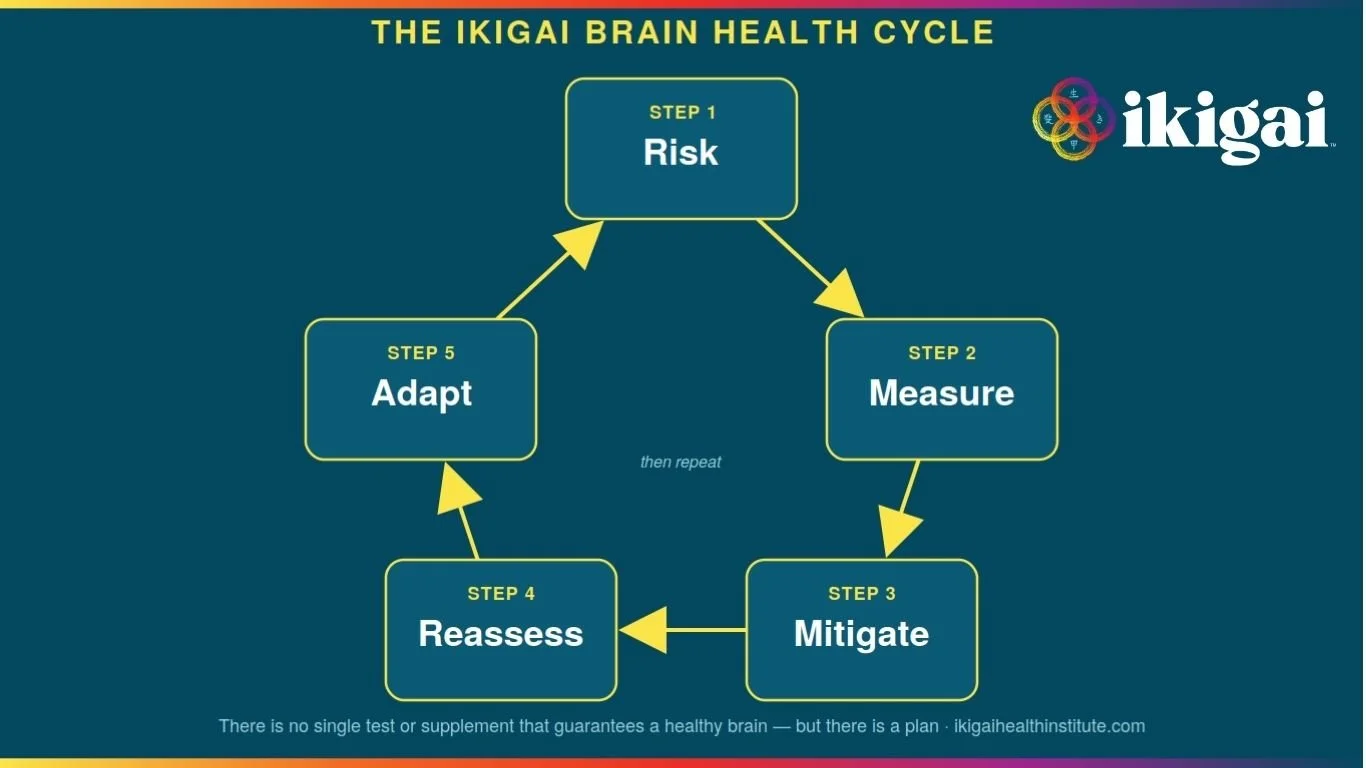
A real brain health plan follows one repeating cycle: understand your risk, measure what matters, mitigate what you can, reassess, and adapt. There's no single test, diet, or supplement that guarantees a healthy brain — but there is a process, and it's the same one we use with every patient at Ikigai.
What's in this post?
Start with your risk, not a test: Why the plan begins with a conversation, not a lab order.
Measure what matters: The simple test for whether a test belongs in your plan.
Find the biggest levers: Why one change often improves five problems at once.
Turn "healthy" into an action plan: Moving from good intentions to something you can actually follow.
Reassess — did it actually work?: The step almost everyone skips.
Then adapt: Why brain health is a strategy, not a checklist.
Don't build a plan only around Alzheimer's: What "brain healthspan" really means.
You can start now: Where to begin today.
What Is a Brain Health Plan, Actually?
We hear some version of this surprisingly often: "I thought there was nothing you could really do to prevent dementia." That would certainly make brain health simpler. It would also be wrong. Age matters. Genetics matter. Some neurologic diseases remain poorly understood. But a meaningful portion of dementia risk is associated with factors we can influence — and after months spent exploring those factors one at a time, it's time to put them together into an actual plan.
The 2024 Lancet Commission estimated that addressing 14 potentially modifiable risk factors could prevent or delay nearly half of dementia cases at a population level. That does not mean 45% of your personal risk can simply be erased. It means something more useful: dementia is not merely something we have to wait around and hope we don't develop.
Throughout our Brain Health series, we've explored the individual pieces — blood pressure, vascular disease, metabolic health, exercise, sleep, hearing, alcohol, smoking, depression, social isolation, and more. Now it's time to assemble them. At Ikigai, we think of brain health as a continuous process: understand your risk, measure what matters, mitigate what you can, reassess, and adapt the plan. The last part is important. Brain health is not a project you finish. It's a strategy that evolves with you.
Start With Your Risk, Not With a Test
There is an understandable temptation in modern preventive medicine to begin with testing. Get an APOE genotype. Order a brain MRI. Take a cognitive test. Measure a collection of biomarkers. We use testing extensively at Ikigai, but testing is not where we start. We start with the person.
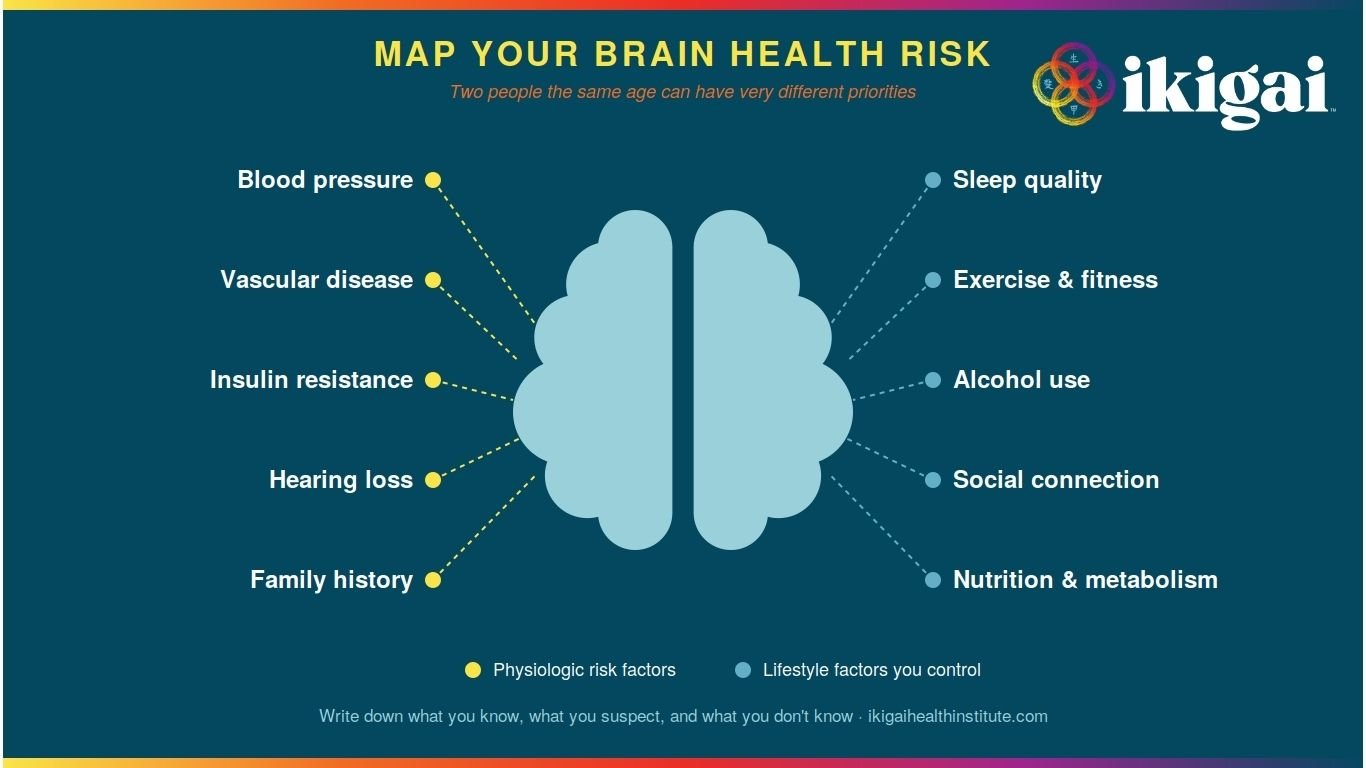
Imagine you walked into our office tomorrow and said, "I want to do everything reasonable to protect my brain." Before deciding what to measure, we'd want to understand what might actually place your brain at risk. That includes the obvious things — your age, family history, and potentially your genetics. But the list quickly grows broader. What is your blood pressure? Do you have evidence of atherosclerosis? Are you insulin resistant? How well do you sleep? Could you have sleep apnea? How physically active and fit are you? Do you smoke? How much alcohol do you drink? How is your hearing? Have you experienced depression? Are you socially connected? Does your life continue to challenge you intellectually? What medications are you taking?
For women, the menopausal transition may add another layer to that picture. For someone with diabetes, hypertension, significant vascular disease, or a strong family history of dementia, other risks may deserve greater attention. Two people of exactly the same age can therefore have very different brain-health priorities.
Think of this as building your risk map. You can start it yourself: write down the things you know, the things you suspect, and — just as important — the things you simply don't know.
Measure What Matters
Once you understand the questions, measurement becomes far more useful. Some measurements are remarkably simple. Blood pressure is inexpensive and can be tracked at home. Lab testing can reveal important information about lipids, glucose regulation, nutritional deficiencies, and more — though it helps to know what an optimal range actually looks like, not just a "normal" one. Hearing can be formally evaluated. Sleep apnea can be diagnosed. Fitness and physical capacity can be measured rather than estimated.
Other assessments are more specialized. Cognitive testing can establish a baseline across different domains of brain function. Brain imaging may reveal vascular injury, structural abnormalities, or other findings that deserve attention. Genetic testing can sometimes refine risk, and more advanced testing may be appropriate for select individuals.
But more data are not automatically better. Before ordering almost any test, ask yourself a simple question: What will I do differently with the result? If the answer is "nothing," think carefully about whether the test belongs in your plan. The goal is not to build the thickest medical file. It's to uncover information that helps you make better decisions.
Find the Biggest Levers
Suppose your risk map identifies ten things that could potentially be improved. Trying to optimize all ten at once is rarely the best strategy. Some risks are larger than others, some have stronger evidence behind them, and some are far more modifiable. Often, improving one problem also improves several others.
Exercise is a perfect example. Regular physical activity is associated with lower dementia risk, but its effects extend far beyond the brain — improving cardiovascular fitness, insulin sensitivity, blood pressure, sleep, mood, body composition, vascular function, and physical independence, all at once. Treating sleep apnea can improve sleep quality while also helping blood pressure, metabolic health, and cardiovascular risk. Improving metabolic health can affect glucose regulation, vascular health, inflammation, and several pathways associated with brain aging.
This is why a brain-health plan should never become a simple checklist of dementia risk factors. The factors interact. Look for the biggest levers — the changes most likely to move multiple parts of your health at once.
Turn "Healthy" Into an Action Plan
"Exercise more." "Eat healthy." "Get better sleep." "Reduce stress."
All excellent advice. None is much of a plan.
A plan converts broad intentions into actions you can actually follow and, when possible, measure. If exercise is a priority, what are you doing each week — training aerobic fitness, strength, and balance? If blood pressure is a concern, are you measuring it accurately at home and responding to the results? If sleep is poor, is the problem insufficient time in bed, insomnia, alcohol, sleep apnea, or something else entirely?
Nutrition provides another good example. The useful goal isn't a list of "brain foods," but a dietary pattern that supports healthy metabolism, body composition, vascular health, and adequate nutrition over decades. The same logic applies to supplements. Asking "What's the best supplement for my brain?" is usually less useful than asking whether there's an actual nutritional or physiologic gap that needs addressing.
Specificity changes behavior. It also gives us something to reassess.
Reassess: Did It Actually Work?
This is the step people frequently skip. You identified a problem and did something about it — but did it work? If your blood pressure was elevated, did it come down? If your metabolic health was poor, did it improve? If you started exercising, did your fitness and strength actually change? If sleep apnea was diagnosed, is treatment effective? If a nutritional deficiency was corrected, did the relevant marker normalize?
This is one reason establishing meaningful baselines matters. A single measurement tells you where you are; repeated measurements tell you where you're going. Sometimes reassessment confirms the plan is working. Sometimes it tells you it isn't. Both are useful information.
Then Adapt
This is where a brain-health plan becomes a living strategy rather than a preventive-health checklist. Maybe your blood pressure is now excellent, but your glucose regulation has begun to change. Perhaps your fitness improves dramatically, but sleep deteriorates. A hearing test that was normal at 52 may not be normal at 62. Menopause changes the physiologic landscape for women. Medications change, injuries change how we exercise, family history may become clearer as relatives age, and new medical evidence emerges.
Your life changes, too, and the plan should change with it. At Ikigai, reassessment isn't the end of the process — it feeds back into the beginning:
Risk → Measure → Mitigate → Reassess → Adapt.
Then repeat.
We are not trying to predict your health perfectly 30 years into the future. We are trying to continually improve the trajectory as new information becomes available.
Don't Build a Plan Only Around Alzheimer's Disease
Protecting your brain is about more than avoiding an Alzheimer's diagnosis. Throughout this series, we've discussed cognitive reserve, attention, vascular injury, metabolism, sleep, chronic stress, depression, hearing, social connection, purpose, and intellectual engagement. These factors influence not only the risk of cognitive decline, but how well the brain functions along the way.
Brain healthspan means preserving your ability to learn, remember, reason, solve problems, make decisions, maintain relationships, and remain independent for as much of your life as possible. We don't merely want you dementia-free at 75. We want you cognitively capable, physically independent, socially connected, curious, and fully engaged with your life. Those are different ambitions, and they require thinking about brain health long before disease appears.
You Can Start Now
You don't need a sophisticated brain-health program to begin. Start by building your risk map. Know your blood pressure. Understand your metabolic and vascular health. Look critically at your exercise, sleep, hearing, alcohol use, nutrition, mental health, social connection, and cognitive engagement. Understand your family history. Identify what you know and what you don't.
Then resist the urge to fix everything at once. Pick the risks that matter most. Measure them appropriately. Create specific interventions. Give those interventions enough time to work, and then reassess. Most importantly, change the plan based on what you learn.
There is no single diet, exercise program, supplement, blood test, genetic result, or brain scan that guarantees a healthy brain. The encouraging message from this entire series is almost the opposite: brain health is shaped by many interacting factors accumulating over decades, and that gives us many opportunities to influence the trajectory.
So the next time someone tells you there's nothing you can do to prevent dementia, don't accept the premise. We cannot control everything, and no serious clinician should promise that we can. But we can understand risk, measure intelligently, intervene where it matters, learn from the results, and keep adapting as we go.
That may not be a guarantee. But it is a plan.
Take the Next Step
A personalized brain health plan starts with understanding your own risk map. If you're ready to move from good intentions to an actual strategy, we'd welcome a conversation.
Schedule a Consultation — Build a personalized brain health plan grounded in your risk, your data, and your goals.
Join the Ikigai Newsletter — Get our Insights series delivered to your inbox.
Explore Our Programs — See how Ikigai integrates brain health into a complete longevity strategy.
Recommended Reading
Brain Health Is Built, Not Found — The foundational framework this series — and this playbook — builds on.
Dementia Risk Factors: What You Can Control — A closer look at the 14 modifiable risk factors referenced above.
Identifying Your Personal Risk — How to build the risk map this plan starts with.
Exercise and Brain Health — Why movement is one of the biggest levers in the entire plan.
Sleep and Brain Health — The companion piece on why sleep quality belongs on every risk map.
Vascular Health and Brain Health — How blood pressure and vessel health shape cognitive aging.
Social Connection and Brain Health — Why purpose and connection belong in the plan, not just the checklist.
References
The information in this post is for educational purposes only and is not intended as medical advice. Always consult with a physician before beginning any new health protocol.
